


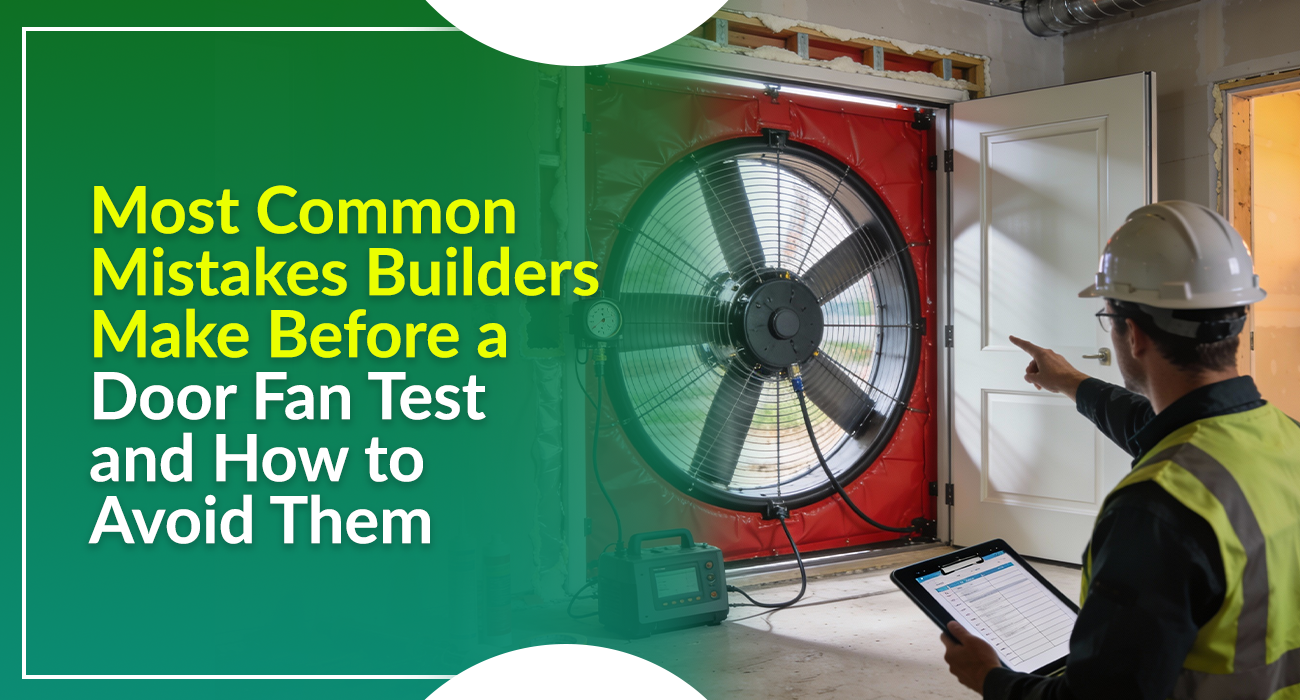
Most Common Mistakes Builders Make Before a Door Fan Test and How to Avoid Them
When it comes to ensuring building safety and compliance, a door fan test is often the make-or-break inspection many projects face. Whether you’re preparing a server room, a data center, or a clean-agent fire suppression area, a failed test means extra work sealing leaks, re-testing, added delays and costs. That’s why companies like Cornerstone Middle East emphasize strict adherence to prep work and inspection protocols before the fan even spins.
In this blog, we explore the most common mistakes builders make before a door fan test drawn from industry best practices, testing standards, and inspection experiences and how to avoid them.
What Is a Door Fan Test And Why It Matters
A door fan test (also called a room integrity test or blower-door-type test, depending on context) is a method to assess how airtight a room is. A calibrated fan is temporarily mounted in a doorway; the fan pressurizes or depressurizes the room, and measurements of air flow and pressure differences reveal how much air leaks through cracks, openings, or penetrations.
This test is especially critical when a room is protected by a clean-agent fire suppression system such as FM-200, Novec, or inert gas because the system’s effectiveness depends on the room being sealed enough to hold the extinguishing agent at the required concentration for a minimum “hold time” (often 10 minutes) after discharge.
Beyond fire safety, for general airtightness or building-envelope testing scenarios (common in energy-efficient or certified buildings), a similar “blower door” method is used to gauge leakage, energy loss, HVAC load, and indoor air quality.
Because the procedure depends entirely on tight seals and accurate measurement protocols not just a working fan many things can go wrong before the test even begins.
Common Mistakes Builders Make Before a Door Fan Test
Below are the most frequent and consequential mistakes that tend to lead to failed tests or unreliable results.
1. Inadequate Pre-Test Room Preparation
It is surprising how often essential preparation steps are skipped. Builders may overlook sealing obvious leak points or fail to account for hidden ones. Some typical slip-ups:
- Gaps around windows, doors, skirting boards, ceilings/floors, or transitions (e.g., between wall and floor).
- Unsealed penetrations: cable trays, electrical conduits, plumbing, HVAC ducts, light fixtures all provide leakage paths.
- Open vents, extract fans, chimneys, or service shafts left unsealed.
- Failure to close or properly seal doors and windows, or to block small residual gaps around frames.
When these leaks are not sealed, the fan test may easily fail or worse, yield misleading results that give a false sense of security.
2. Treating Airtightness and Integrity as Afterthoughts
Another widespread mistake is waiting until the very end of fit-out or finishing to address sealing and airtightness. By then, walls, ceilings, ducts, and utility runs are all in place and sealing becomes complicated, messy, or even impossible without major rework. This “air-barrier as an afterthought” approach drastically reduces the likelihood of success.
In high-performance or fire-protected rooms (e.g., data centers, server rooms), envelope sealing and continuity must be considered during initial design not left to contractors at the end. Unfortunately, many builders overlook this until the test is scheduled.
3. Choosing the Wrong Time or Conditions for Testing
Many builders schedule the test too late often right before handover, after drywall, finishes, cabinetry, services and mechanical systems are installed. At this stage, leaks are difficult to detect or rectify without tearing off finishes. This reduces the chances of passing the test.
Worse, sometimes external factors weather, wind, temperature/humidity are ignored. Unfavorable conditions can skew results: for example, wind can push or pull air through small gaps, making a room appear leakier than normal; high/low temperature could affect pressure and density readings.
4. Assuming All Trades Know About Airtightness and Coordinating Poorly
In many projects, airtightness is “someone else’s job” drywallers, plumbers, electricians, HVAC installers, and others each make penetrations but assume the sealing responsibility is someone else’s. This diffusion of responsibility often results in multiple unsealed or partially sealed penetrations.
When trades don’t coordinate, leaks accumulate. Cable trays, ducts, plumbing sleeves, light fixtures, junction boxes all of them become potential weak points unless sealed methodically. And because the door fan test is sensitive, even “small” leaks can cause failure.
5. Failing to Define the Test Boundary or Room Volume Properly
One subtle but critical mistake is not clearly defining what space will be tested: what boundaries walls, ceilings, floors are included, and what penetrations are accounted for. Without a clear test boundary, you cannot accurately calculate leakage metrics or decide what needs sealing.
Incorrect boundary definitions lead to poor measurement, erroneous results or a meaningless test.
6. Choosing Inexperienced or Inappropriate Test Service Providers
A door fan test is only as good as the team performing it. Using unqualified or inexperienced providers can introduce errors: incorrect fan range, misconfigured manometer or software settings, poor calibration, lack of pre-test checklist, and inadequate documentation.
Because the test is metrological (quantitative) in nature not just a rough “smoke-pen leak hunt” attention to detail and strict adherence to standard protocols (as specified under guidelines such as NFPA 2001, ISO 14520 and, for other airtightness contexts, standards like Passive House Standard or relevant local building codes) is indispensable.
Consequences of These Mistakes From Failed Tests to Safety Risks
When any of the above mistakes occur, the implications go beyond minor retesting. Some of the immediate and long-term consequences include:
- Test failure or invalid results: meaning delays and added costs for resealing and retesting.
- Compromised integrity of fire suppression systems: if leaks exist, a gaseous agent may escape too quickly in the event of discharge: the room may not retain required concentration long enough, risking incomplete fire suppression or reignition.
- Energy inefficiency and increased operating costs: in cases where airtightness is related to HVAC efficiency, leaky buildings mean poor thermal control, increased HVAC load, drafts, moisture ingress, poor indoor air quality.
- Regulatory non-compliance: leading to failing audits, failing building certification (e.g., green building standards), or being unable to commission critical systems (fire suppression, data centers, etc.).
- Rework and schedule slippage: sealing leaks after finishes may require breaking walls, ceilings, or redo of service installations time-consuming and costly.
How to Avoid These Mistakes Best Practices Before Your Door Fan Test
To avoid the pitfalls above, here’s a practical checklist and approach based on testing & inspection best practices.
- Plan Airtightness & Integrity from Day One
- Include air-barrier/room-integrity considerations during design and early construction not after finishes.
- Clearly define the “test boundary” which walls, ceiling, floor, penetrations are part of the sealed envelope.
- Coordinate with all trades (electrical, plumbing, HVAC, data, etc.) so that penetrations are planned and sealed properly.
- Include air-barrier/room-integrity considerations during design and early construction not after finishes.
- Prepare the Room Thoroughly Before Testing
- Seal all windows, doors, vents, ducts, and HVAC openings. Close or temporarily block vents, extract fans, chimneys.
- Seal all penetrations: cable trays, pipes, light fixtures, electrical boxes, HVAC ducts with appropriate materials (foam, fire-caulk, grommets, airtight sleeves).
- Seal transitions: wall-to-floor, wall-to-ceiling, skirting, junctions even seemingly minor gaps.
- Remove or isolate any items that might interfere with pressure equalization (loose contents, furniture, obstacles that block airflow).
- Ensure environmental conditions are suitable avoid strong wind, extreme temperature/humidity swings, or heavy precipitation if possible.
- Seal all windows, doors, vents, ducts, and HVAC openings. Close or temporarily block vents, extract fans, chimneys.
- Use Qualified, Certified Testing Professionals
- Engage a recognized, experienced firm for example, Cornerstone Middle East, which lists Room Integrity Testing (door fan test) among its specialized services.
- Ensure they use calibrated equipment (fan, manometer), correct software settings, proper test configuration, and follow standard protocols.
- Insist on full documentation: test boundary description, room volume, fan specification, calibration certificates, measured pressure/flow data, equivalent leakage area (or leakage rate), test conditions (temperature, wind), and pass/fail status. This helps for compliance, certification, and future audits.
- Engage a recognized, experienced firm for example, Cornerstone Middle East, which lists Room Integrity Testing (door fan test) among its specialized services.
- Schedule Testing at the Right Stage And Be Ready for Re-tests
- Ideally perform the test when the air-barrier layer is complete but before finishes cover walls/ceilings or make sealing difficult.
- Plan for at least one retest leaks are common, and sealing after first test and before finishing helps avoid costly rework.
- If possible, perform intermediate “commissioning” leak tests during construction to catch issues early.
- Ideally perform the test when the air-barrier layer is complete but before finishes cover walls/ceilings or make sealing difficult.
- Treat Airtightness and Integrity as Integral to the Building Not as a Compliance Tick-box
- Understand that airtightness affects not just test pass/fail but long-term performance: fire safety, energy efficiency, indoor air quality, HVAC sizing & operation, occupant comfort, durability.
- Build awareness among all stakeholders architects, contractors, mechanical and electrical engineers, project managers about the importance of air barriers and leak prevention.
- Understand that airtightness affects not just test pass/fail but long-term performance: fire safety, energy efficiency, indoor air quality, HVAC sizing & operation, occupant comfort, durability.
Why Partnering with Experts Like Cornerstone Middle East Makes a Difference
When you work with Cornerstone Middle East for your door fan test (or related airtightness/integrity testing), you get:
- Experienced technicians trained to conduct room integrity tests in compliance with standards such as NFPA 2001, ISO 14520, or EN 15004, depending on project requirements.
- Access to advanced and calibrated testing equipment, precise measurement and analysis, and thorough documentation of results from measured leakage to recommended remediation.
- Comprehensive testing services beyond just fan testing: visual inspections, pressure differential measurement, building envelope evaluation, air-leakage diagnostics, and reporting.
- Guidance on compliance, retrofit needs, and best practices, helping builders avoid repeated failures and align with fire-safety and integrity regulations.
For builders who treat door fan test as a critical part of the project not as a last-minute checkbox partnering with a competent firm like Cornerstone Middle East can mean the difference between a smooth certification and costly delays.
Realistic Scenario: What Typically Goes Wrong and How to Catch It Before It’s Too Late
Consider a typical data-center project or a critical server room being fitted for a clean-agent fire suppression system:
- Walls, ceiling, and floor are constructed, but different trades (electrical conduits, cable trays, HVAC ducts, sprinkler penetrations) install their services independently, without thinking about airtight integrity.
- The project moves quickly: electricians finish, then plumbers, then HVAC, then fire suppression installation, each trade punching holes or cutting sleeves, often out of sight of the others.
- Nearing project completion, the design team remembers the pending door fan test, but by now, walls are painted, ceiling tiles installed, ducts closed, and sealing leaks now means undoing parts of the finish or rerouting services.
- Under time pressure before handover, they opt for a quick smoke-pen check rather than a full blower-door-type integrity test, and some leaks get missed. The test fails, but they try again without addressing all leaks, and perhaps finally pass, but with many small leaks still present.
- Result: in a real fire event, the gaseous suppression system discharges instead of retaining concentration for the required hold time, the gas escapes through those leaks; fire may not be extinguished, or residual risk remains high.
This scenario, unfortunately common and illustrates how poor coordination, lack of planning, and inadequate pre-test work can seriously compromise safety.
By contrast, when a testing firm like Cornerstone Middle East is engaged early and given the scope to perform full room integrity testing (with door fan), leaks are identified while shell and mechanical works are still open, sealing is done properly, and retest confirms compliance long before finishing resulting in a safe, reliable, and compliant room.
Conclusion
A door fan test is not just a formal procedure it’s a critical check that determines whether a protected space will perform safely and effectively in an emergency. The difference between pass and fail often lies not in the sophistication of the fan or the testing equipment, but in the attention paid to preparing the building envelope, sealing leaks, coordinating trades, and following rigorous protocols.
Sadly, many builders still treat such testing as a last-minute chore. By then, structural finishes and services are completed and sealing becomes far harder or impossible without rework. That often leads to repeated tests, project delays, wasted resources or worse, compromised safety.
If you truly care about the integrity of your building, airtightness, fire safety, and compliance, partner with an experienced and qualified firm like Cornerstone Middle East for your door fan test and treat pre-test preparation as part of the construction process, not an afterthought. That’s the difference between a building that simply checks the box and a building that stands up to real-world safety, performance, and longevity demands.


Post a comment