


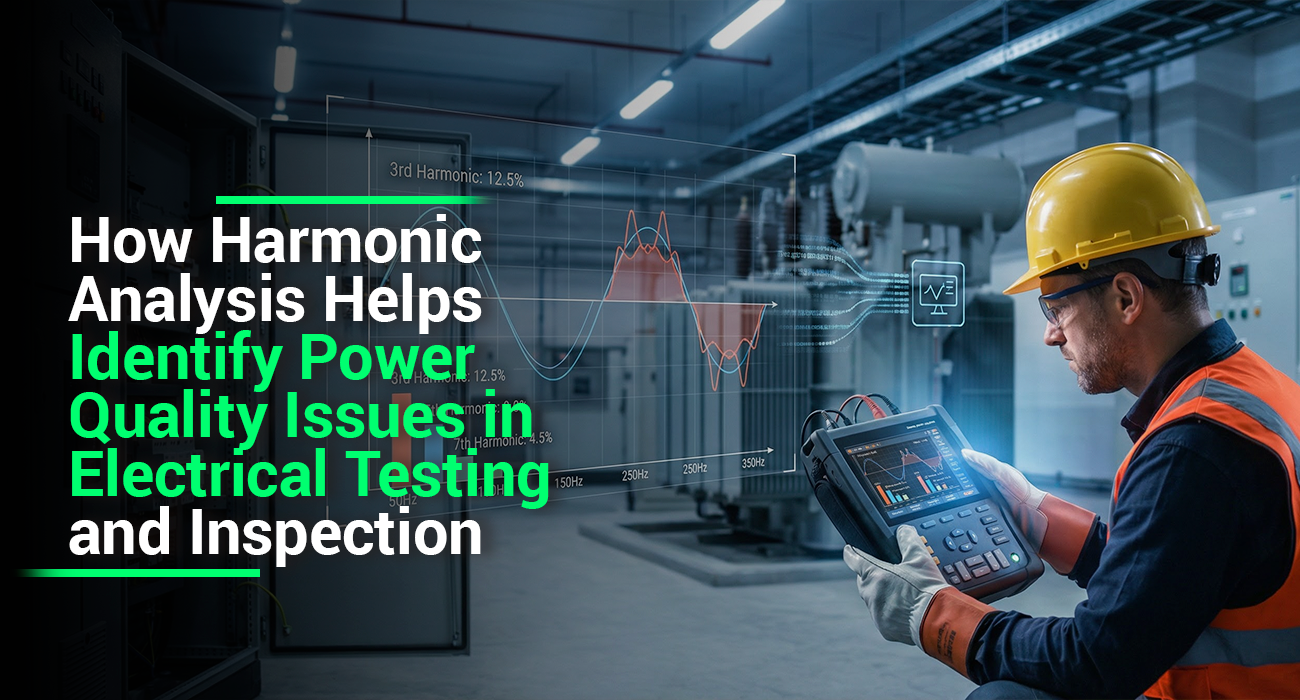
How Harmonic Analysis Helps Identify Power Quality Issues in Electrical Testing and Inspection
In today’s increasingly electrified world, reliable power systems are the backbone of industrial operations, commercial buildings, data centers, and infrastructure projects. However, modern electrical networks face growing challenges due to nonlinear loads, sensitive equipment, and complex distribution systems. These challenges often appear as unexplained equipment failures, overheating, voltage distortion, and energy inefficiencies.
This is where harmonic analysis and power quality analysis become critical tools in professional electrical testing and inspection. By identifying hidden disturbances within electrical networks, these techniques help engineers detect problems early, optimize system performance, and protect valuable assets.
At Cornerstone Middle East, advanced testing and inspection methodologies are used to assess power systems comprehensively, ensuring safety, compliance, and operational reliability. Through structured electrical assessments, their specialists leverage harmonic analysis and power quality analysis to uncover issues that conventional inspections often miss.
This article explores how harmonic assessment fits into modern electrical testing practices and why it plays such a vital role in identifying power quality issues across industrial and commercial environments.
Understanding Power Quality in Modern Electrical Systems
Power quality refers to the stability and purity of electrical power delivered to equipment. Ideally, voltage and current waveforms should remain smooth, balanced, and sinusoidal. In reality, electrical systems are affected by a wide range of disturbances, including voltage sags, swells, flicker, transients, and harmonic distortion.
Poor power quality can lead to malfunctioning machinery, reduced equipment lifespan, data errors, overheating transformers, nuisance tripping of breakers, and increased energy costs. As facilities integrate more electronic devices such as variable frequency drives, UPS systems, LED lighting, and automation controls, power distortion becomes increasingly common.
Professional power quality analysis helps identify these abnormalities by measuring waveform deviations, voltage stability, and current behavior over time. When combined with harmonic analysis, engineers gain deeper insight into the root causes behind persistent electrical issues.
Cornerstone Middle East incorporates these diagnostic techniques into structured testing and inspection programs, allowing facility owners to address problems before they escalate into costly failures.
What Is Harmonic Distortion and Why Does It Matter
Harmonics are voltage or current frequencies that are multiples of the fundamental power frequency. These distortions are generated primarily by nonlinear loads, which draw current in abrupt pulses rather than smooth waves. Common sources include inverters, rectifiers, computers, elevators, and HVAC systems.
While individual devices may appear harmless, their cumulative effect can significantly distort electrical waveforms. Over time, harmonic distortion can cause transformers to overheat, neutral conductors to carry excessive current, capacitors to fail prematurely, and sensitive electronics to behave unpredictably.
This is why harmonic analysis has become a cornerstone of modern electrical testing. It allows engineers to measure harmonic levels, identify dominant frequencies, and determine how distortion propagates through the system.
When paired with power quality analysis, harmonic assessments provide a complete picture of electrical health, enabling informed decisions about mitigation strategies such as filters, system redesign, or load balancing.
The Role of Harmonic Analysis in Electrical Testing and Inspection
Electrical testing and inspection is no longer limited to visual checks and insulation resistance measurements. Today’s facilities require deeper diagnostic insight to ensure system integrity under real operating conditions.
Harmonic analysis plays a central role in this advanced approach. During inspections, portable power analyzers are installed at key points in the distribution network to record voltage and current waveforms over extended periods. These instruments capture harmonic spectra, total harmonic distortion (THD), and load behavior during normal operations.
By applying power quality analysis, engineers can correlate harmonic patterns with operational events such as equipment startup, peak demand periods, or process cycles. This helps pinpoint specific sources of distortion and assess their impact on upstream and downstream components.
Cornerstone Middle East integrates these measurements into comprehensive inspection reports, providing actionable recommendations that improve system performance while ensuring compliance with international electrical standards.
Identifying Hidden Power Quality Issues Through Harmonic Measurement
Many electrical problems remain invisible until significant damage has already occurred. Harmonics often fall into this category because they do not always trigger immediate alarms or shutdowns.
Through systematic harmonic analysis, inspectors can detect early warning signs such as elevated neutral currents, abnormal transformer heating, or unexpected voltage distortion. These findings often explain recurring breaker trips, unexplained equipment failures, or inconsistent production output.
Meanwhile, power quality analysis reveals additional parameters such as voltage imbalance, frequency variation, and transient events. Together, these tools uncover underlying issues that traditional inspections may overlook.
At Cornerstone Middle East, this proactive approach enables clients to address vulnerabilities before they lead to operational downtime or safety risks.
Impact of Harmonics on Industrial and Commercial Equipment
Harmonics affect different types of equipment in unique ways. Motors may experience torque pulsations and increased losses, reducing efficiency and lifespan. Transformers can overheat due to additional eddy current losses. Capacitor banks may resonate with harmonic frequencies, leading to catastrophic failure.
Sensitive electronics such as PLCs, servers, and medical equipment are particularly vulnerable to distorted power. Even minor deviations can cause communication errors, data corruption, or system resets.
By conducting regular harmonic analysis as part of routine inspections, engineers can assess how these distortions impact critical assets. Complementary power quality analysis provides context, showing how voltage stability and load dynamics interact with harmonic levels.
Cornerstone Middle East emphasizes this integrated methodology to protect client investments and maintain uninterrupted operations.
Compliance, Standards, and Best Practices
International standards such as IEEE 519 and IEC guidelines define acceptable harmonic limits for electrical systems. Meeting these standards is essential not only for equipment protection but also for regulatory compliance and insurance requirements.
Professional testing teams use harmonic analysis to compare measured values against prescribed thresholds, identifying areas where corrective action is required. Simultaneously, power quality analysis ensures voltage levels, phase balance, and frequency stability align with recommended practices.
Cornerstone Middle East structures its inspection programs around these benchmarks, delivering detailed documentation that supports compliance audits and long-term asset management.
Integrating Harmonic Analysis into Preventive Maintenance Programs
Preventive maintenance has evolved beyond mechanical servicing to include advanced electrical diagnostics. Incorporating harmonic analysis into maintenance schedules allows organizations to track trends over time and detect gradual degradation.
Repeated power quality analysis provides historical data that helps engineers identify emerging risks such as increasing distortion levels or deteriorating voltage profiles. This predictive insight enables targeted interventions rather than reactive repairs.
Cornerstone Middle East works closely with facility managers to develop customized inspection strategies that integrate harmonic monitoring, thermal imaging, and conventional electrical testing into a unified maintenance framework.
Practical Applications Across Industries
The benefits of harmonic analysis and power quality analysis extend across numerous sectors. Manufacturing plants rely on stable power for automation systems. Data centers require pristine electrical environments to protect servers. Healthcare facilities depend on uninterrupted power for life-critical equipment.
In commercial buildings, harmonic distortion from lighting systems and HVAC equipment can reduce energy efficiency and comfort levels. Even infrastructure projects such as airports and metro systems depend on clean power to ensure reliable operations.
Through specialized testing and inspection services, Cornerstone Middle East supports diverse industries by identifying electrical weaknesses and recommending tailored mitigation solutions.
From Diagnosis to Solution: Turning Data into Action
Collecting electrical data is only the first step. The true value of harmonic analysis lies in interpreting results and implementing corrective measures. Engineers analyze harmonic spectra to determine whether passive filters, active filters, or system redesign is required.
Likewise, power quality analysis informs decisions about voltage regulation, load redistribution, or equipment upgrades. These recommendations are presented in clear, actionable reports that help stakeholders prioritize investments.
Cornerstone Middle East focuses on translating technical findings into practical solutions, ensuring clients achieve measurable improvements in reliability and efficiency.
Why Professional Testing Makes a Difference
While portable analyzers are widely available, accurate diagnosis requires expertise in measurement techniques, system behavior, and standards interpretation. Professional inspectors understand how harmonics interact with real-world electrical networks and how to isolate root causes.
By combining harmonic analysis with comprehensive power quality analysis, Cornerstone Middle East delivers insights that go far beyond basic readings. Their multidisciplinary approach integrates electrical engineering knowledge with field experience, producing results clients can trust.
Future Trends in Power Quality Assessment
As electrical systems become more complex, the demand for advanced diagnostics continues to grow. Smart grids, renewable energy integration, and electric vehicle infrastructure introduce new harmonic challenges.
Modern inspection programs increasingly rely on continuous monitoring, cloud-based analytics, and predictive modeling. Yet the fundamentals remain the same: understanding waveform behavior through harmonic analysis and evaluating system performance via power quality analysis.
Cornerstone Middle East stays at the forefront of these developments, adapting its testing methodologies to meet evolving industry needs.
Conclusion
Power quality issues are rarely accidental; they develop over time due to changing loads, aging equipment, and expanding infrastructure. Identifying these problems early requires more than surface-level inspections.
Through structured harmonic analysis and detailed power quality analysis, electrical testing professionals gain visibility into hidden disturbances that compromise system health. These insights empower organizations to enhance reliability, improve energy efficiency, and extend equipment life.
Cornerstone Middle East brings this expertise to every inspection project, combining advanced measurement tools with engineering insight to deliver dependable results. By embedding harmonic assessment into routine testing and inspections, they help clients maintain safe, compliant, and resilient electrical systems today and well into the future.


Post a comment