


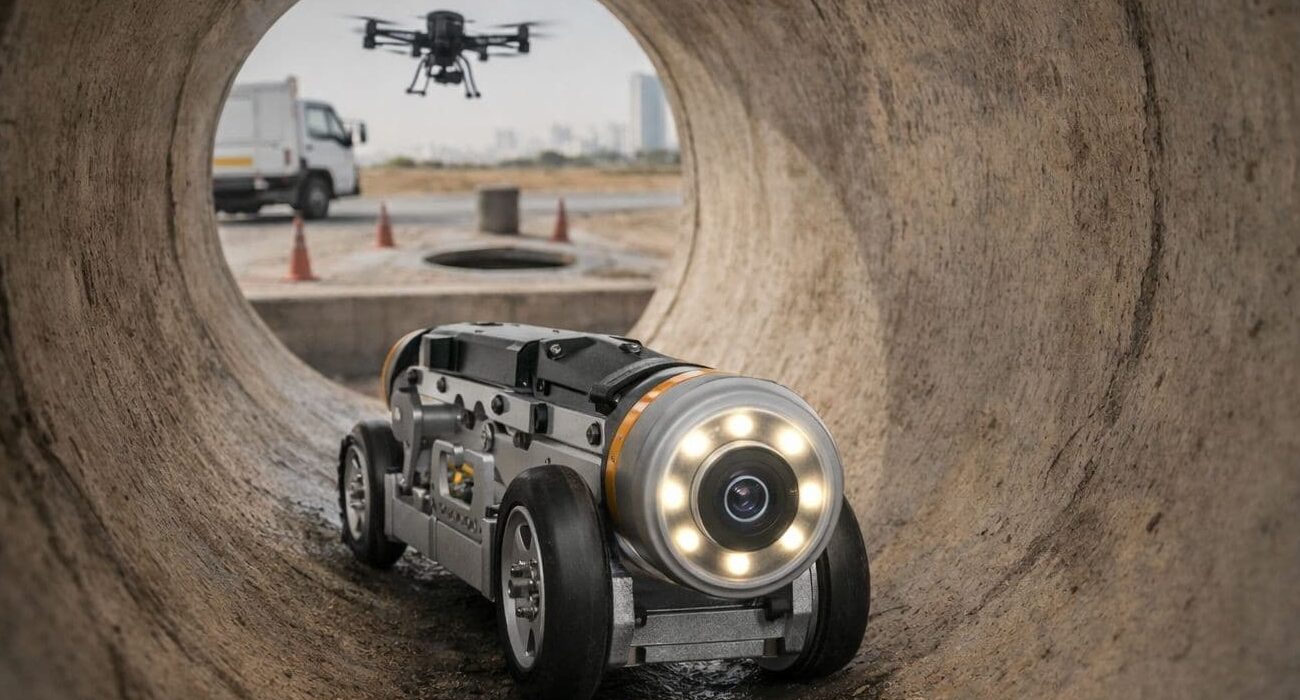
The Biggest Risk in Infrastructure Is The One You Cannot See. How CCTV Pipeline Inspection Helps
Why CCTV pipeline inspection has become the foundation for safer projects, faster approvals, and fewer claims in the Middle East, with drones accelerating visibility above ground
As infrastructure networks age under rising demand, decision-makers can feel more confident and in control knowing that CCTV pipeline inspection provides critical visibility for safer, more informed decisions.
Across the Gulf, infrastructure teams are under growing pressure. Networks installed during earlier growth cycles are operating beyond their original design assumptions. Urban density is increasing faster than capacity expansion. Budgets are scrutinised more closely, while safety, environmental, and compliance expectations continue to rise.
Yet despite advances in design tools and construction methods, one fundamental risk continues to undermine project outcomes. Many critical decisions are still made without knowing what is actually happening inside the asset.
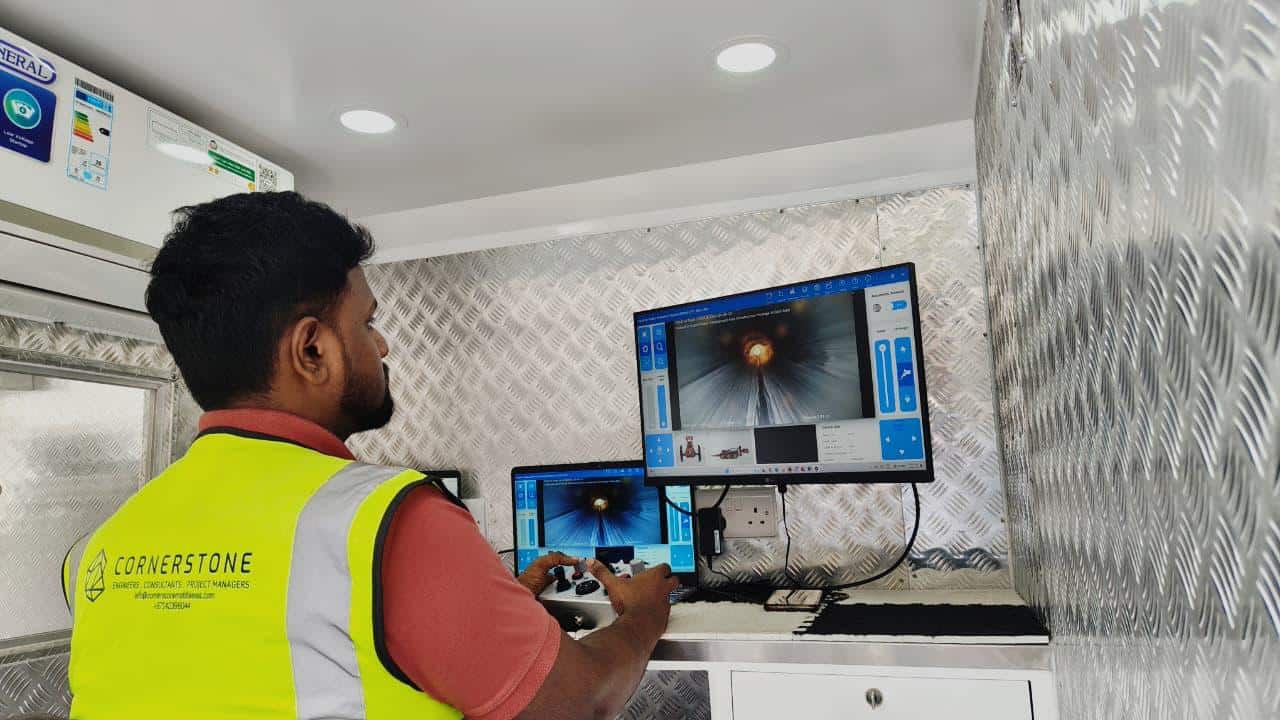
Pipeline failures rarely begin with visible warning signs. They develop gradually, out of sight, until the cost of intervention escalates and the margin for control disappears. By the time surface symptoms appear, the opportunity for efficient, planned action has often passed.
This is why CCTV pipeline inspection has moved beyond being a maintenance task. It has become a strategic tool for risk management, cost control, and decision-making.
The visibility gap beneath modern infrastructure
Underground infrastructure presents a unique challenge. Once assets are buried, they become invisible, but they remain essential.
In the Middle East, much of today’s wastewater, drainage, and utility infrastructure was installed during periods of rapid expansion in the 1990s and early 2000s. Many of these systems now operate under higher loads, harsher environmental conditions, and alongside newer networks that were never designed to interact with them.
Engineering drawings capture intent, not condition. Two pipes of the same age and material can perform very differently due to soil movement, groundwater conditions, loading, quality, and maintenance history. Without internal inspection, asset owners and project teams are left to manage risk based on assumptions rather than evidence.
CCTV inspection closes this gap by converting buried infrastructure into visible, measurable systems that can be assessed, prioritised, and managed.
Why CCTV inspection now sits at the centre of better decisions
CCTV pipeline inspection is often perceived as a compliance requirement or a pre-handover check. In reality, its value lies in how it shapes decisions.
When appropriately executed, CCTV inspection delivers five critical outcomes. It identifies what is wrong, where it is located, how severe it is, why it is occurring, and the following action to take. That clarity directly impacts outcomes across the infrastructure lifecycle.
How different stakeholders use CCTV to reduce risk
Infrastructure contractors
For contractors, underground works carry inherent uncertainty. Pricing and planning without internal condition data exposes margins to risks that often emerge only after mobilisation.
CCTV inspection enables contractors to accurately define the scope, confirm rehabilitation feasibility, reduce unnecessary contingencies, and protect themselves during handover and warranty periods.
In an increasingly competitive market, inspection-led scoping not only provides a commercial advantage but also offers measurable ROI by reducing unforeseen costs, minimising delays, and optimising resource allocation through accurate condition data.
Municipalities and wastewater authorities
Public-sector asset owners face the challenge of preventing failures while justifying expenditure within fixed budgets and under high public scrutiny.
CCTV inspection allows municipalities to prioritise high-risk assets before failure, transition from reactive interventions to planned maintenance, and support funding decisions with defensible data. It also provides auditable records that support regulatory compliance and public accountability.
The result is infrastructure managed as a portfolio rather than a series of emergencies.
Utilities
Utilities are judged on reliability. Service disruptions carry regulatory, financial, and reputational consequences.
CCTV inspection supports utilities by identifying defects before they affect service, reducing repeat failures through root-cause visibility, and enabling performance reporting aligned with regulatory requirements. When inspection data is integrated into asset management systems, it becomes operational intelligence rather than static documentation.
Developers
For developers, uncertainty translates directly into delays and financial exposure.
CCTV inspection helps accelerate approvals for new connections, protects developers during handover and warranty periods, supports due diligence for acquired assets, and reduces the risk of late-stage discoveries that delay occupancy.
In high-value developments, inspection is not an overhead. It is a form of insurance against risk.
From footage to intelligence
The value of CCTV inspection does not lie in video footage alone. Actual risk reduction comes from structured outputs that support engineering decisions, helping stakeholders feel assured and supported in managing infrastructure effectively.
Without these elements, inspection remains observational rather than strategic.
At Cornerstone Middle East, inspections are approached as engineering deliverables. Every inspection is expected to inform a decision, not simply create a record.
Where drone inspections add value
Drone technology complements modern inspection strategies. Above-ground access constraints, safety risks, and time delays can limit visibility, but drones mitigate these challenges by enabling rapid, safe surveys of large or otherwise inaccessible areas, complementing CCTV inspections that provide detailed internal condition assessments for comprehensive asset evaluation.
Used together, drones enable efficient targeting, while CCTV inspections confirm internal conditions. One improves speed and safety. The other delivers certainty.
A practical approach to implementation
Effective inspection programmes do not need to be complex. A practical starting point is to identify assets where failure carries the highest consequences, inspecting to support decisions rather than achieve blanket coverage, converting findings into a prioritised action list, and repeating the process consistently.
This phased approach builds control and confidence without creating unnecessary operational burden.
Five things to expect from a CCTV inspection provider:
1. Defect classification that supports engineering decisions
2. Accurate distance measurement and location referencing
3. Severity grading linked to recommended actions
4. Consistent reporting quality and turnaround times
5. Documentation that withstands audit and dispute
Looking ahead
Inspection data is no longer the end product. It is becoming the input. The next phase of infrastructure management will integrate CCTV and drone inspection data into asset management platforms, giving utility managers and developers confidence and a clear path forward for future challenges.
In infrastructure, the most significant risks are rarely hidden by complexity. They are hidden by what remains unseen.


Post a comment