

Curtain Wall Water Penetration Testing in the UAE: A Practical Guide to ASTM E1105
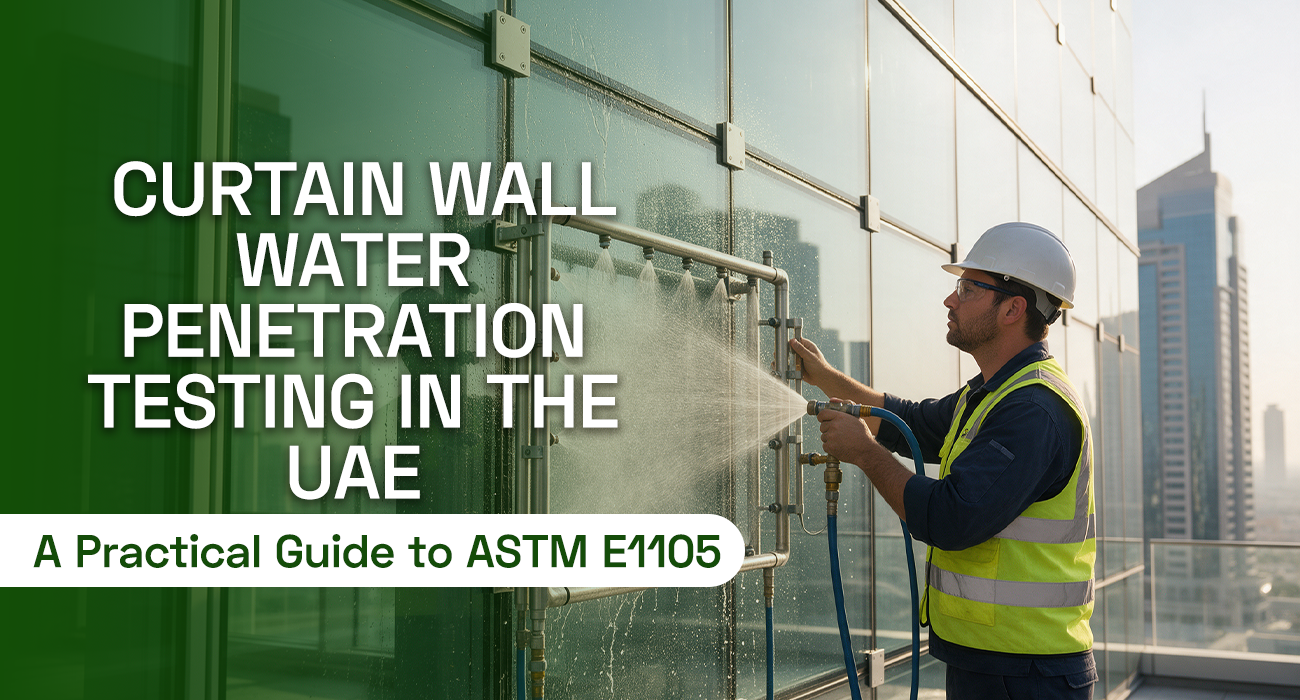
Curtain Wall Water Penetration Testing in the UAE: A Practical Guide to ASTM E1105
A curtain wall can look perfect on drawings, pass its laboratory mock-up, and still leak once it’s installed on a tower in Abu Dhabi or Dubai. The difference is usually workmanship: a sealant joint tooled in 44°C heat, a gasket that didn’t seat at a mullion intersection, a weep hole blocked with debris. Site water penetration testing is how we find those problems before handover, while they are still cheap to fix.
This guide explains how we carry out curtain wall water testing on UAE projects, what ASTM E1105 and AAMA 501.2 actually require, what counts as a failure, and the defects we find most often.
Why site water testing matters in the UAE
Rain in the UAE is infrequent, but when it comes it is often short, heavy and wind-driven. That combination pushes water into joints under pressure, which is exactly the condition a poorly sealed facade can’t handle. Add high coastal humidity, dust, and daily thermal swings that work sealant joints hard, and small installation defects become leaks over time.
Water that gets past a curtain wall rarely shows up straight away. It can sit in insulation, corrode brackets and anchors, and damage interior finishes long before anyone sees a stain on the ceiling. By then the fix involves occupied floors, access equipment and a much bigger bill.
That’s why many consultants and main contractors in the UAE now include site water testing in the facade specification, with documented results required before the system is accepted.
What ASTM E1105 is (and what it isn’t)
ASTM E1105 is the standard test method for the field determination of water penetration of installed exterior windows, skylights, doors and curtain walls. It is carried out on the building, on the facade as installed, using a uniform or cyclic static air pressure difference combined with a calibrated water spray.
It is not a laboratory method. Laboratory and mock-up water testing is covered by different standards:
Stage | Water penetration | Air infiltration | Structural |
|---|---|---|---|
Laboratory / mock-up | ASTM E331 (static), ASTM E547 (cyclic) | ASTM E283 | ASTM E330 |
Installed on site | ASTM E1105 (chamber), AAMA 501.2 (hose) | ASTM E783 | n/a |
Keeping these apart matters. When a specification asks for “E1105 testing,” it’s asking for a site test on the installed facade, not a repeat of the mock-up.
The two site water tests you’ll see on UAE projects
ASTM E1105 chamber test
This is the more rigorous of the two, because it combines water spray with a pressure difference that simulates wind.
- Chamber set-up. A sealed chamber is built against the interior face of the selected facade area, usually covering at least one full bay including vertical and horizontal joints.
- Spray rack. A calibrated spray rack is set up on the exterior face, delivering water uniformly at 3.4 L/m² per minute.
- Pressure. Air is extracted from the chamber so the interior is at a lower pressure than the exterior. The test pressure is a single value set by the specification, commonly two-thirds of the laboratory water test pressure, following AAMA 503 guidance for field testing.
- Procedure A or B. Under Procedure A, the pressure is held steady while water is sprayed, typically for 15 minutes. Under Procedure B, the pressure is cycled on and off during the spray period. The specification should state which one applies.
- Observation. Our technicians watch the interior face throughout the test and record the time, location and nature of any water that appears.
- Diagnosis. If water penetration is found, we isolate the source by masking areas and retesting, so the contractor knows exactly which joint, gasket or seal to fix.
Some specifications also ask for a diagnostic series at increasing pressures to find the point at which leakage begins. That’s useful, but it’s an addition to the standard, not part of the standard pass/fail test.
AAMA 501.2 hose test
The hose test is quicker and is widely used across the UAE for checking installed curtain walls, especially on large facades where chamber testing every bay isn’t practical. A calibrated nozzle at a controlled water pressure is directed at joints and glazing seals from a set distance, working slowly along each joint while an observer checks the inside. There’s no air pressure difference, so it checks the continuity of seals rather than performance under wind load.
On most projects the two tests work together. The hose test gives broad coverage across many bays, and chamber testing under E1105 provides the pressure-based verification the specification calls for on selected areas.
What counts as a failure
This is the part that causes most arguments on site, so it’s worth being precise.
Under ASTM E1105, water penetration means water that passes beyond the innermost plane of the test specimen, not counting interior trim and hardware. Water that enters a curtain wall’s pressure-equalised cavity or drainage channels and is then carried back out through the weep system is not a failure. That’s the system working as designed.
A failure is water that reaches the interior side of that inner plane, whether as a drip, a wet patch on the frame, or water running down the inside face. The specification may add its own acceptance criteria, so we always confirm these with the consultant before testing starts.
The defects we find most often
Across the facades we test, the same issues come up again and again:
- Sealant joints. Wrong joint depth, poor adhesion because the substrate wasn’t cleaned or primed, or sealant applied outside the manufacturer’s temperature limits.
- Gasket problems. Gaskets shrunk back, not fully seated, or not properly joined at corners and at mullion and transom intersections.
- Blocked or missing weeps. Drainage paths filled with debris, sealant or insulation, so water that should drain out builds up and finds another route in.
- Interfaces. Poor flashing or seal continuity where the curtain wall meets slab edges, parapets, other cladding types or openings.
- Unsealed penetrations. Fixings, brackets and anchor points that were drilled or adjusted after the seals were installed.
- Movement joints. Stack and expansion joints that weren’t detailed or installed to handle thermal movement.
Most of these are workmanship issues, not design issues, which is exactly why a passed mock-up doesn’t guarantee a watertight building.
When to test
We recommend planning site water testing at three points:
- Early in installation, on the first completed bays. Finding a systematic defect on floor 3 is far better than finding it on floor 30.
- At intervals during installation, as set by the specification, typically covering a percentage of the facade area.
- Before handover, including any areas that were repaired after earlier tests.
For existing buildings with leaks, water testing is also the most reliable way to trace the actual entry point, rather than guessing and resealing the wrong joint.
How we work at Cornerstone Middle East
At Cornerstone Middle East, facade performance testing is one of our core services. We carry out site water penetration testing to ASTM E1105 and AAMA 501.2 on projects across Abu Dhabi and Dubai, from commercial towers to landmark cultural buildings.
Our facade testing work covers:
- Site water penetration testing (ASTM E1105 chamber and AAMA 501.2 hose)
- Site air leakage testing
- Mock-up test witnessing and support
- Leak investigation for existing buildings
- Supervision of facade remediation works
Every test is run by our trained technicians using calibrated equipment. Our reports record the test standard and procedure, test pressure, spray rate, duration, the areas tested, and the exact location of any water penetration, with photographs and marked-up elevations. Where we find a leak, we tell you where it’s coming from and what needs fixing, so the contractor can close it out and we can retest quickly.
Frequently asked questions
How long does an ASTM E1105 test take?
The water spray period itself is usually 15 minutes per test area. Chamber set-up, calibration and any diagnostic retesting add to this, so plan for most of a day per test location.
What pressure is used in a site water test?
The test pressure is set by the project specification. It’s commonly two-thirds of the pressure used for laboratory water testing of the same system.
Does water in the frame mean the curtain wall failed?
Not necessarily. Water that enters the drainage cavity and drains back out through the weeps is normal. It’s a failure only when water passes the innermost plane of the system into the building.
What’s the difference between ASTM E1105 and AAMA 501.2?
ASTM E1105 uses a sealed chamber to apply air pressure while water is sprayed, simulating wind-driven rain. AAMA 501.2 uses a calibrated hose nozzle with no pressure difference, and is used to check seal continuity along joints.
Can you test an occupied building?
Yes. Chamber and hose testing can both be carried out on occupied buildings with planning around access, interior protection and tenant coordination.
Talk to us about your facade
If your project is approaching facade installation, mock-up review or handover, or you’re dealing with leaks in an existing building, get in touch and we’ll help you plan the right testing programme.


Post a comment