


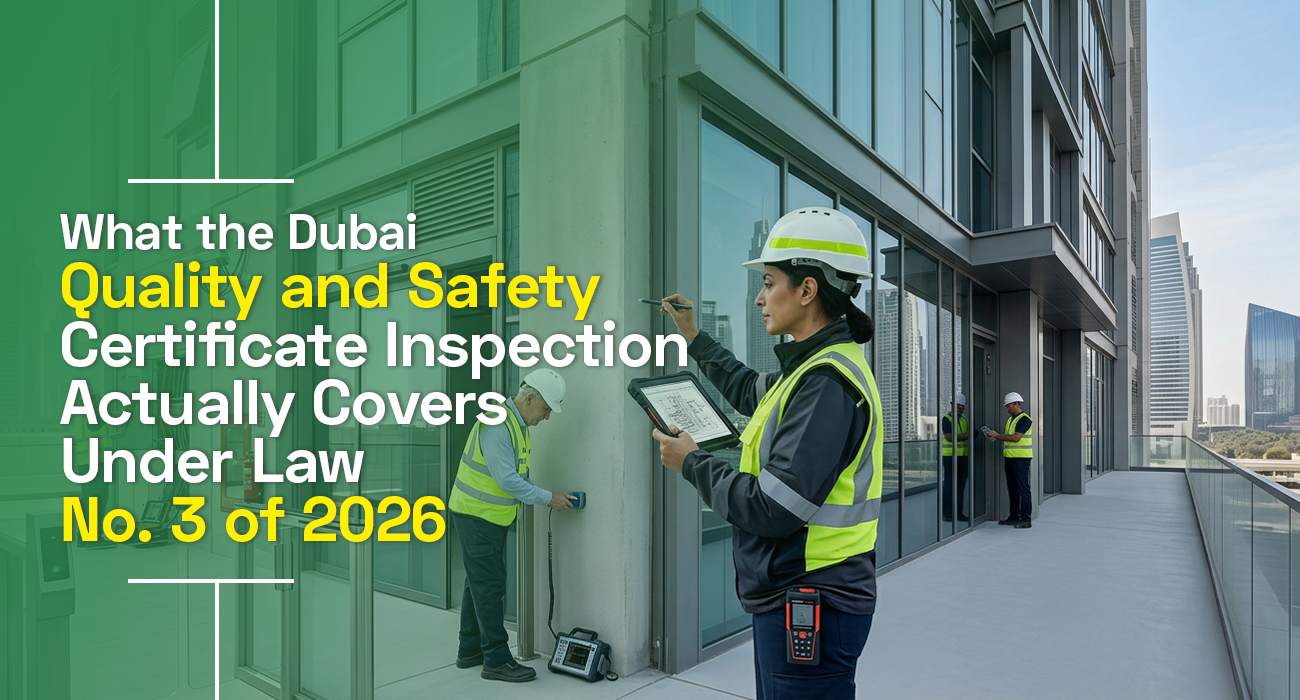
What the Dubai Quality and Safety Certificate Inspection Actually Covers Under Law No. 3 of 2026
Every building owner in Dubai is now working against the same legal fact: Law No. 3 of 2026 requires every building in the emirate mainland properties, private developments, and free zones including the DIFC to hold a valid Quality and Safety Certificate. The certificate cannot be requested, purchased, or self-declared. It can only be issued after a technical inspection is carried out by an engineering office licensed and accredited by Dubai Municipality.
This obligation sits with the people who legally control the asset: owners, developers, jointly-owned property (strata) owners, and the management entities responsible for common areas and building operations. It applies whether the building was completed decades ago or handed over last year, and it applies regardless of whether the property sits in a free zone that previously ran its own building standards.
That last point is worth sitting with. Prior to this law, free zones such as the DIFC operated under their own building governance frameworks, separate from Dubai Municipality’s mainland rules. Law No. 3 of 2026 removes that distinction for the purposes of building safety certification. A landlord who owns a unit in a DIFC tower and a landlord who owns a unit in a mainland tower in Business Bay are now subject to the same inspection standard, the same certificate structure, and the same enforcement regime. For owners with portfolios that span both jurisdictions, this closes a gap that previously allowed for different compliance postures depending on where an asset sat.
Before appointing anyone or budgeting for the process, it’s worth understanding what the law actually requires an inspector to look at because that’s the part most searches on this topic are really trying to answer. Owners searching for “Dubai building safety certificate” or “Quality and Safety Certificate inspection” are typically past the stage of wondering whether the law applies to them. What they need is a clear picture of the technical scope, so they know what to expect on-site, what might get flagged, and roughly what kind of remediation budget to hold in reserve.
What “Inspection” Legally Means Under the Law
The certificate is tied to a technical assessment, not a paperwork filing. This is a meaningful distinction, and it’s the first thing to get straight before contacting an engineering office. The Quality and Safety Certificate is not issued on the basis of a declaration, an existing completion certificate, or a desk review of building records. It is issued only after a licensed engineering office physically evaluates the building’s structural and technical condition and produces a formal technical report.
In practice, that means there is no administrative shortcut. A building cannot be “fast-tracked” to certification by submitting existing documentation alone. The inspecting engineering office has to assess the physical building which is the reason people researching this topic want to know, specifically, what gets checked before they call anyone. The answer, drawn from how the law frames the certification requirement, breaks down into four broad areas of assessment.
It also means the inspection is a two-way process rather than a formality that ends once a technician walks through the building. If the engineering office identifies defects during the assessment, those defects generally need to be addressed and in some cases re-inspected before the certificate is issued. This is a structurally different arrangement from a routine annual maintenance check-up. A maintenance visit tells you what’s wrong; a Quality and Safety Certificate inspection determines whether the building is legally permitted to continue operating without remediation.
The Four Areas a Quality and Safety Certificate Inspection Assesses
1. Structural Integrity
This is the foundation of the assessment, in the literal sense. Inspectors evaluate the load-bearing condition of the building columns, beams, slabs, and foundations looking for signs of deterioration, cracking, corrosion of reinforcement, water ingress damage, or any defect that could compromise the structure’s ability to carry its intended loads safely. For older buildings in particular, this is the area most likely to surface issues that require remediation before a certificate can be issued, since decades of use, weather exposure, and deferred maintenance all leave a measurable mark on structural elements.
Coastal and high-humidity conditions in Dubai make reinforcement corrosion a particularly common finding in structures approaching or past the 40-year mark, since exposed rebar and concrete spalling tend to accelerate once moisture penetration begins. Inspectors will typically look for visible cracking patterns, staining consistent with water ingress, and any signs of structural movement or settlement, in addition to reviewing whether the building’s original structural design still matches its current use a relevant question for buildings that have been repurposed or had additional load added over time (extra floors, heavier equipment, structural alterations) without a formal reassessment.
2. MEP Systems
Mechanical, electrical, and plumbing systems are assessed for both condition and safe operation. This covers the building’s core operational infrastructure: electrical distribution and wiring safety, HVAC systems, plumbing and drainage, and other mechanical installations that keep a building functional and safe for occupants day to day. An inspection here isn’t just about whether systems currently work it’s about whether they’re operating within safe parameters and whether their condition suggests a near-term failure risk.
For commercial and mixed-use buildings, this assessment tends to be more involved simply because there’s more infrastructure to review chillers, generators, elevators, and building management systems all fall within scope, in addition to the base electrical and plumbing network. Owners of buildings with older MEP installations, or buildings where systems have been serviced reactively rather than on a preventive schedule, should expect this to be one of the more time-consuming parts of the inspection.
3. Safety Infrastructure
This category focuses on fire and life-safety systems: fire detection and alarm systems, suppression systems, emergency lighting, means of egress, and related safety infrastructure that determines how a building performs in an emergency. Given that occupant protection is one of the law’s stated purposes, this area of assessment carries particular weight, and deficiencies identified here are among the most likely to trigger a required remediation before certification.
This is also the area where inspection findings can carry the most immediate urgency. A structural finding might be scheduled for repair over a longer timeline with monitoring in between, but a non-functional fire alarm panel or a blocked emergency exit route is the kind of defect that regulators and engineering offices tend to treat as requiring prompt correction, given the direct life-safety risk involved.
4. Overall Technical Condition
Beyond the three specific categories above, inspectors form a broader judgment on the building’s general technical condition and maintenance state essentially, how well the building has been looked after as a whole, and whether its current performance matches what would be expected for a structure of its age and use. This is where the inspection moves from checking individual systems to forming an overall picture of the building’s health.
A note on facades: building envelopes and facades are relevant to this inspection, but they aren’t treated as a freestanding, separately legislated category. Based on how the assessed areas are framed, facade condition is best understood as a component that feeds into both the structural integrity assessment (cladding fixings, weatherproofing, water ingress) and the safety infrastructure assessment (fire-rated facade materials, fall risk from deteriorated elements). Owners of buildings with older or non-compliant cladding systems should expect facade condition to come under scrutiny, even though it isn’t called out in the law as its own standalone pillar.
Certificate Validity — Why Timing Matters
Once issued, a Quality and Safety Certificate isn’t a one-time achievement. Its validity period depends directly on the age of the building:
- 10 years for buildings under 40 years old
- 5 years for buildings 40 years or older
This tiered structure means that older buildings face a compounding timing problem. Not only are they statistically more likely to have deferred-maintenance issues that surface during inspection, they’re also on a shorter renewal clock once certified meaning the next inspection cycle, and the next round of potential remediation costs, arrives sooner. An owner of a 45-year-old building isn’t just facing today’s inspection; they’re committing to a recurring five-year compliance rhythm going forward, with re-certification required before the previous certificate lapses.
This is worth internalizing early: certification is not a box to tick once and forget. Owners of older stock, in particular, should build the inspection and renewal cycle into long-term asset planning rather than treating it as a one-off compliance event.
It’s also worth noting that holding a valid certificate doesn’t suspend an owner’s other maintenance obligations in the meantime. The certificate confirms a point-in-time technical assessment; it doesn’t exempt the owner from the ongoing duty to perform periodic maintenance or fix defects that emerge afterward, including any structural damage that occurs between certification cycles. In other words, the certificate and routine maintenance are parallel, ongoing obligations not a sequence where one replaces the other once complete.
Compliance Deadline and Consequences of Not Acting
The law provides a one-year transitional compliance window from its effective date, giving owners time to appoint an engineering office, complete the inspection, address any defects identified, and obtain certification. In practice, Dubai Municipality has also indicated a phased rollout older and higher-risk buildings are being notified first, given that the volume of buildings requiring certification across the emirate substantially outstrips the current capacity of accredited engineering offices. Owners who receive an early notification should treat the deadline attached to it as a hard date, since the process inspection, remediation of any defects, and re-inspection where needed can take considerably longer than a single site visit.
Non-compliance carries a graduated penalty structure. Fines range from AED 100 up to AED 1,000,000, depending on the nature and severity of the violation. Repeat violations committed within a two-year period are subject to doubled penalties, reaching up to AED 2,000,000.
Financial penalties aren’t the only consequence. Authorities can also impose administrative measures that hit an owner’s ability to operate or transact, including:
- Suspension of building permits
- Holds on Dubai Land Department (DLD) transactions and approvals related to the property
- Suspension of lease certification for units within the building
For an owner planning to sell, refinance, or lease units, these non-monetary consequences can be more disruptive than the fine itself a transaction hold or lease certification block can stall a deal entirely, regardless of how large or small the underlying violation was. A pending sale can’t close cleanly against a DLD transaction hold, and a landlord can’t lease certify new units in a building that’s currently non-compliant meaning the practical cost of delay tends to compound well beyond the administrative fine on its own.
This also means certification status is becoming a due diligence item for buyers and tenants, not just a compliance item for owners. Anyone evaluating a Dubai property whether for purchase, lease, or investment now has a reasonable basis to ask whether the building holds a current, valid Quality and Safety Certificate, and if not, what compliance phase it falls under and when certification is expected.
Who’s Responsible for What
The law splits responsibility between two parties, and it’s worth being clear on where each one’s obligations start and stop.
The building owner is responsible for appointing a licensed engineering office, obtaining the Quality and Safety Certificate, maintaining the building on an ongoing basis, and rectifying any technical defects identified during the inspection process. Notably, obtaining periodic maintenance or completing repairs on your own initiative doesn’t substitute for the formal inspection and certification process the two obligations run in parallel, not as alternatives to each other.
The engineering office is responsible for conducting the inspection itself and preparing the technical report that documents the building’s condition against the four assessed areas outlined above. Choosing the right accredited engineering office one with the right licensing, the right sector experience, and the capacity to handle remediation follow-up is its own decision with real consequences for timeline and cost, and deserves separate treatment beyond the scope of this article.
Close: The Regulator’s Role
Dubai Municipality sits at the center of this framework, not as a passive record-keeper but as the operational backbone of the entire certification regime. It licenses and accredits the engineering offices authorized to conduct inspections, maintains a unified digital database of building records and certification status, and provides ongoing oversight of compliance across the emirate including the phased notification process currently being rolled out to owners of the oldest and highest-risk buildings first.
Law No. 3 of 2026 formalizes something that was previously inconsistent across Dubai’s mainland, private development, and free zone jurisdictions: a single, unified standard for what “safe” and “compliant” actually mean for a building, verified on a recurring cycle rather than assumed indefinitely from the date of original completion.


Post a comment