


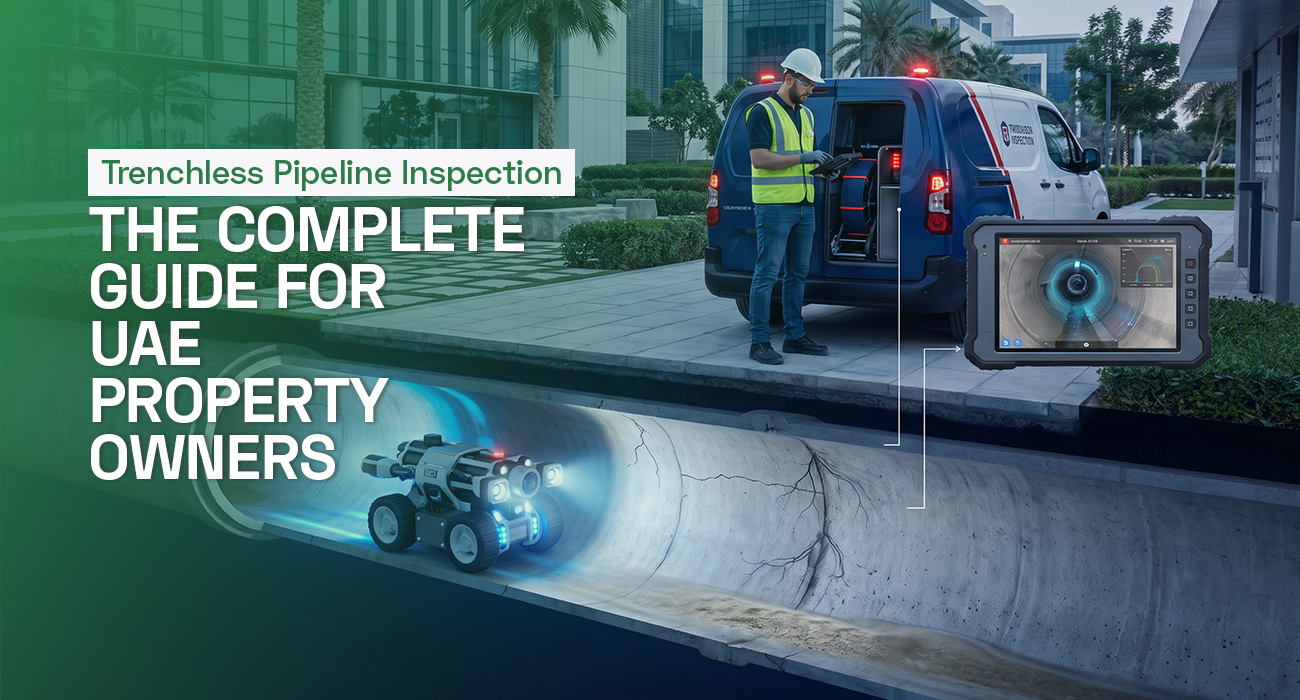
Trenchless Pipeline Inspection: The Complete Guide for UAE Property Owners
A blocked drain, a damp patch on the lawn, a musty smell near the kitchen sink the first sign of an underground pipe problem is almost never underground. It shows up somewhere else entirely, which is exactly why guessing at the cause is so unreliable.
For most of the last century, the only way to really know what was happening inside a buried pipe was to dig it up and look. That approach is slow, expensive, and often unnecessary. Trench less pipeline inspection changes the equation. A small camera travels through the pipe itself, recording exactly what condition it’s in, without a single shovel touching the ground.
This guide explains what trenchless pipeline inspection actually involves, the technology behind it, what it can reveal, and why it has become the standard first step before any drainage repair in UAE whether the pipe belongs to a home, a commercial site, or a council-owned network.
What Is Trenchless Pipeline Inspection?
Trenchless pipeline inspection is the process of examining the inside of an underground pipe using a camera or sensor system fed through existing access points, rather than excavating along the pipe’s length to expose it.
The most common form is CCTV drain inspection, where a waterproof camera is pushed or driven through the pipe on a flexible rod or a self-propelled crawler unit. The camera feeds a live video image back to the technician above ground, along with a location signal that maps the exact position of anything it finds.
Because the inspection uses access points that already exist an inspection chamber, a manhole, a gully pit, or a cleanout there’s typically no digging involved at all. The pipe stays buried, the property stays untouched, and the technician gets a complete, recorded picture of its internal condition from one end to the other.
This is the diagnostic step that sits before any decision about repair. It’s also, increasingly, a standalone service in its own right used for pre-purchase property checks, routine asset maintenance, insurance claims, and compliance reporting.
Why Inspection Comes Before Any Repair Decision
It’s tempting to jump straight to a fix once a problem is suspected. But without knowing exactly what’s wrong, where it is, and how severe it is, any repair decision is a guess dressed up as a plan.
A pipe that looks fine from the surface can be cracked, root-affected, corroded, or partially collapsed several metres down. Two pipes with identical symptoms above ground a slow drain, a bad smell, a soggy patch of lawn can have completely different causes below it. One might need a five-minute clear-out. Another might need a full section replaced.
Trenchless inspection removes the guesswork. It tells a property owner or contractor:
- Exactly what type of defect is present a crack, a fracture, an open joint, root intrusion, corrosion, or a full collapse
- Precisely where the defect sits along the pipe run, usually to within a few centimetres
- How severe the defect is, and whether it’s likely to worsen
- Whether the surrounding pipe is structurally sound enough for a trenchless repair, or whether excavation is unavoidable
That last point matters more than most people realise. Trenchless point repair the resin-lined patch method used to fix localised defects without digging can only be used on a pipe that’s structurally sound around the damaged section. Without an inspection first, there’s no reliable way to know if that condition is met. Choosing a repair method before inspecting the pipe is choosing blind.
How Trenchless Pipeline Inspection Actually Works
The process is more methodical than most people expect, and it follows a consistent sequence regardless of whether the job is a suburban home or a stretch of council stormwater main.
Locating access points
The first step is identifying how to get into the pipe network without digging. Most residential and commercial properties already have inspection openings, junction points, or a boundary trap that can be used. Where no suitable access point exists, a small, purpose-built access point may need to be created still a far smaller intervention than a full excavation.
Camera selection
Not every pipe needs the same equipment. Smaller residential lines are usually surveyed with a push-rod camera, a self-levelling camera head mounted on a flexible rod that a technician feeds through the pipe by hand, watching the live feed as they go. Larger diameter pipes, longer runs, or main sewer and stormwater lines are more efficiently surveyed with a self-propelled crawler unit, which drives itself through the pipe on small wheels or tracks and can carry pan-and-tilt cameras for a full 360-degree view of the pipe wall.
For very large stormwater culverts or pipes carrying water that can’t be shut off, sonar and laser profiling equipment is sometimes used alongside or instead of a camera, measuring the internal shape and diameter of the pipe even where visibility is poor.
Recording and locating
As the camera moves through the pipe, the footage is recorded continuously, along with an on-screen distance counter. A sonde a small transmitter built into the camera head sends a signal that a technician can trace from the surface with a locating wand, marking the exact above-ground position of any defect found below. This is what allows a repair crew to return later and work on precisely the right spot, rather than opening up a much larger area on guesswork.
Grading the defects
Every defect identified during the inspection is logged and classified against a nationally recognised standard: the WSA 05 Conduit Inspection Reporting Code of Australia, published by the Water Services Association of Australia. This code gives structural and service defects a consistent severity rating, so that a crack found in one pipe is graded the same way a crack would be graded in any other pipe, anywhere in the country. That consistency is what allows a contractor, an insurer, or a council to make an informed decision based on the report rather than a subjective description.
Reporting
The final output is a structured report, combining the recorded footage, defect locations, WSA 05 gradings, and a written summary of findings. For homeowners this is usually a plain-language explanation alongside the footage. For commercial clients, councils, and Water Corporation work, it’s typically a formal report suitable for asset records, tender documentation, or compliance files.
What a Trenchless Inspection Can Reveal
A CCTV drain inspection routinely uncovers issues that would be invisible from the surface and easy to miss with a partial dig:
Cracks and fractures. Hairline cracks, circumferential fractures, and longitudinal splits, often caused by ground movement, tree root pressure, or ageing pipe material.
Root intrusion. Tree and shrub roots seeking moisture will exploit even a tiny gap at a pipe joint, gradually forcing their way in and restricting or blocking flow entirely.
Joint displacement. Pipe sections that have shifted out of alignment at their joints, often due to ground settlement, creating a step or gap that catches debris and lets groundwater in.
Corrosion and deterioration. Particularly relevant in older UAE properties with ageing earthenware, fibre cement, or early PVC pipework, where decades of use has thinned or degraded the pipe wall.
Bellied or sagging pipe. A section of pipe that has dropped out of its correct grade, creating a low point where water pools and solids settle instead of flowing through.
Blockages and build-up. Grease, scale, silt, or foreign objects restricting flow, sometimes the root cause of recurring blockages that clearing alone never fully resolves.
Collapsed sections. The most severe finding, where the pipe has lost its structural shape entirely and no longer functions as a conduit.
Each of these has a different implication for repair. A hairline crack in an otherwise sound pipe might be an ideal candidate for a fast, low-cost trenchless point repair. A collapsed section, by contrast, has no intact host pipe to repair into, and will need to be excavated and replaced. The inspection is what draws that line, rather than a repair crew finding out the hard way once a trench is already open.
When to Get a Trenchless Pipeline Inspection
A handful of situations point clearly to the need for a camera inspection rather than a wait-and-see approach.
Recurring blockages that clear temporarily and then return are a strong signal of a structural cause further down the line, not just a one-off clog. Slow-draining fixtures across multiple points in a property, rather than just one sink or toilet, often indicate a shared line issue rather than a localised one. Damp patches, sunken ground, or unusually lush green strips across a lawn can indicate a leaking pipe feeding moisture into the soil below. Persistent odours near drains, particularly after rain, are frequently linked to cracked or displaced pipework letting gas escape. And any property built before the 1980s, with original earthenware or fibre cement drainage, benefits from an inspection simply on the basis of age and material, even without an active symptom.
Inspection is also standard practice in situations that have nothing to do with an active fault:
- Pre-purchase property inspections, where a buyer wants certainty about the condition of underground drainage before settlement
- Renovation and extension planning, where new structures, driveways, or landscaping will sit over or near existing pipework
- Routine asset maintenance for commercial properties, strata complexes, and council-owned infrastructure, catching problems while they’re still minor
- Insurance claims, where documented evidence of pipe condition and the cause of a failure is required
Trenchless Inspection for Residential vs Commercial and Council Work
The core technology is the same across every job, but the scale and purpose shift depending on the client.
For a residential property, inspection is usually reactive triggered by a specific symptom or precautionary, ahead of a purchase or renovation. The pipe runs are shorter, access points are simpler, and the report is generally a straightforward explanation with supporting footage.
For commercial sites, the stakes are higher and downtime matters more. A blocked or failing line in a retail centre, hospitality venue, or industrial site can affect trading, so inspections are often scheduled to minimise disruption, with reporting geared toward facilities management and compliance needs.
For councils and Water Corporation assets, inspection is frequently part of a planned maintenance program rather than a reaction to a fault. Large sections of stormwater and sewer network are surveyed on a rolling basis, with every defect logged and graded to WSA 05 standards so that limited maintenance budgets can be directed to the pipes that need it most urgently, rather than spread evenly across a network regardless of actual condition.
What Affects the Cost of a Trenchless Pipeline Inspection
Inspection pricing depends on a smaller set of variables than repair pricing, since there’s no excavation or reinstatement to factor in.
Pipe length and access. A short residential run with an easily reached inspection point is quicker and cheaper than a long commercial line requiring multiple access points or a self-propelled crawler.
Pipe diameter. Larger stormwater or sewer mains generally require crawler equipment rather than a simple push-rod camera, which affects the time and equipment involved.
Site conditions. Whether existing access points are usable as-is, or whether a small access point needs to be created first, changes the scope of the job.
Reporting requirements. A basic residential report is a smaller deliverable than a full WSA 05-compliant report prepared for council tender documentation or asset management records.
Urgency. An after-hours or emergency call-out where a drainage failure can’t wait for a scheduled appointment carries a different cost structure than a booked routine inspection.
As a general rule, inspection is a fraction of the cost of even a small trenchless repair, and a very small fraction of an open-cut excavation. It’s a diagnostic cost, not a repair cost and spending that smaller amount upfront is what prevents an unnecessary or oversized repair bill later.
Trenchless Inspection and Trenchless Repair: How They Connect
Inspection and repair are often talked about together, but they answer different questions. Inspection answers “what’s wrong, and where?” Repair answers “how do we fix it?”
The two are connected in a practical sense because the inspection is what makes trenchless repair possible in the first place. A trenchless point repair a resin-saturated liner cured in place inside the existing pipe can only be positioned accurately if the exact location and extent of the defect is known. Without a prior CCTV survey, a repair crew has no reliable way to place a patch precisely, and no way to confirm the surrounding pipe is sound enough to bond into.
This is also why a follow-up CCTV inspection is standard practice after any trenchless or open-cut repair. It confirms the fix has been completed correctly and that the pipe is now clear and structurally sound, closing the loop on the same technology that identified the problem in the first place.
Why Choose Cornerstone Middle East for Trenchless Pipeline Inspection in UAE
Getting an accurate read on a pipe’s condition depends on experienced technicians, proper equipment, and reporting that actually means something once the camera is packed away. Cornerstone Middle East delivers on all three:
- Over 20 years of combined industry experience across sewer and stormwater networks
- More than 500 pipeline defects identified and repaired across UAE and wider Western Australia
- CCTV inspection and WSA 05-compliant reporting for accurate, consistent defect diagnosis
- Push-rod and self-propelled crawler camera capability suited to residential, commercial, and council-scale pipework
- Trenchless point repair and open-cut excavation capability, so the same team that inspects the pipe can also recommend and carry out the right fix
- Experience across residential, commercial, industrial, local government, and Water Corporation work
- 24/7 emergency response across UAE and wider WA
- Solar-fitted site vehicles, reducing both carbon footprint and noise impact in residential areas
Because inspection, repair, and excavation all sit within the one team, clients get a straight answer about what’s actually wrong and what it will genuinely take to fix it not a recommendation shaped by whichever service the contractor happens to offer.
To arrange a trench less pipeline inspection in UAE, call [+971 50 207 9549 ] or email [info@cornerstonemiddleeast.com].
Frequently Asked Questions
Is trench less pipeline inspection the same as trenchless pipe repair?
No. Inspection is a diagnostic process that examines the inside of a pipe using a camera, with no repair work involved. Trenchless point repair is the fix itself, applied once an inspection has confirmed the location and nature of a defect.
How long does a CCTV drain inspection take?
Most residential inspections are completed within an hour or two, depending on the length of pipe run and number of access points. Larger commercial or council surveys covering longer sections take proportionally longer.
Will an inspection damage my property?
No. The camera is fed through existing access points such as inspection chambers, gully pits, or cleanouts. In the rare case a new access point is needed, it’s a small, targeted opening rather than a trench.
Can inspection detect problems that aren’t causing symptoms yet?
Yes. Root intrusion, joint displacement, and early-stage corrosion often show up on camera well before they cause a noticeable blockage or leak, which is why precautionary inspections on older properties are worthwhile even without an active complaint.
Do I need an inspection before every repair?
For any repair beyond clearing a simple blockage, yes. Without knowing the exact location and severity of a defect, there’s no reliable way to choose between a trenchless repair and open-cut excavation, or to know where to dig if excavation is needed.
Do you provide inspection reports suitable for councils or insurers?
Yes. Reports are prepared to the WSA 05 Conduit Inspection Reporting Code of Australia, giving consistent, industry-standard defect grading suitable for asset management records, tender documentation, and insurance claims.
Conclusion
Trenchless pipeline inspection has changed what it means to diagnose a drainage problem. Instead of guessing based on surface symptoms, or excavating speculatively to see what’s there, a camera can now travel the full length of a pipe and show exactly what condition it’s in, without disturbing the ground above it.
That certainty is what makes every decision after it whether to patch, replace, or simply monitor an informed one rather than a guess. For a homeowner dealing with a recurring blockage, a commercial site protecting its uptime, or a council managing kilometres of ageing stormwater infrastructure, the same principle holds: know what’s wrong before deciding how to fix it.
Cornerstone Middle East brings CCTV and crawler-camera inspection, WSA 05-compliant reporting, trenchless repair, and open-cut excavation together under one team, so the diagnosis and the fix are never disconnected. Whatever the pipe, the goal is the same a clear picture first, and the right fix second.


Post a comment