

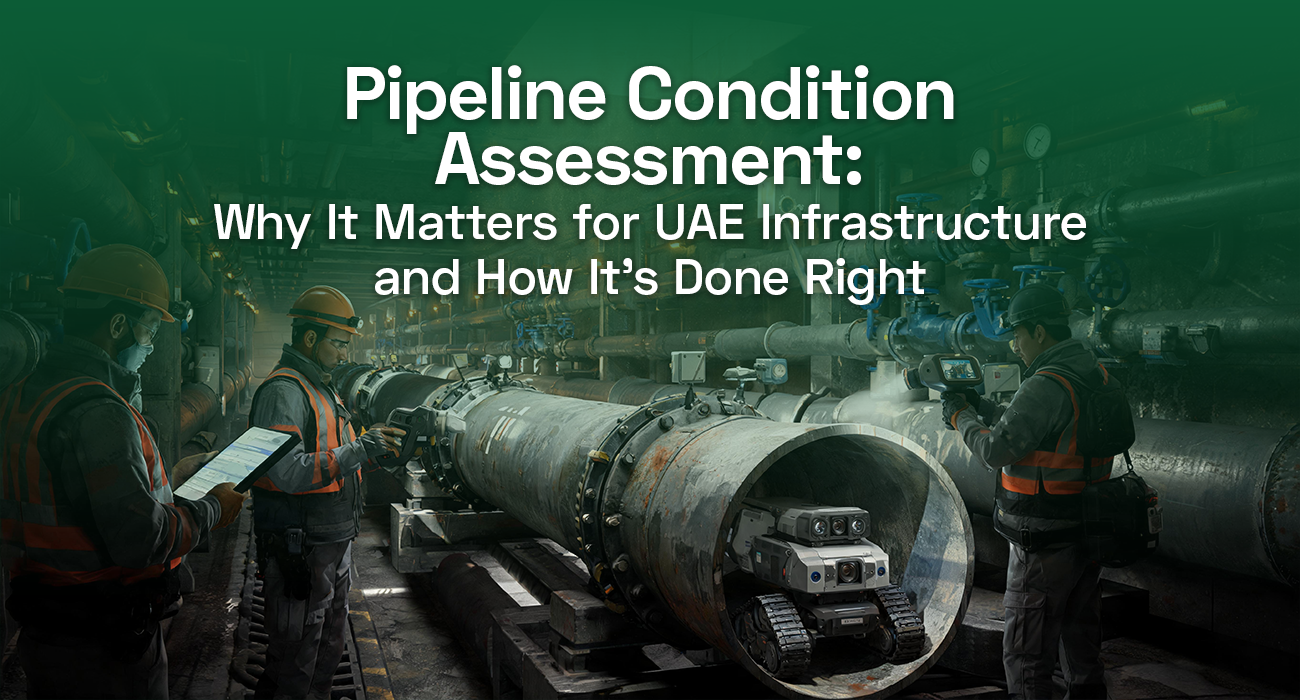
Pipeline Condition Assessment: Why It Matters for UAE Infrastructure and How It’s Done Right
Introduction: Underground, Out of Sight But Never Out of Mind
Beneath the gleaming skylines of Dubai, Abu Dhabi, and Sharjah lies an intricate web of pipelines carrying water, oil, gas, and wastewater the invisible arteries that keep the UAE’s cities and industries alive. These pipelines operate under constant pressure, exposure to corrosive soils, temperature extremes, and the natural degradation that comes with age.
Yet for many asset owners and facility managers, pipelines remain the most neglected part of their infrastructure portfolio simply because they cannot be seen.
That’s where pipeline condition assessment becomes not just valuable, but essential.
Whether you manage a municipal water network, an oil and gas distribution system, or an industrial process pipeline, understanding the current health of your pipeline assets is the foundation of smart asset management. In the UAE where infrastructure investments run into the hundreds of billions and where operational continuity is paramount a proactive approach to pipeline inspection and assessment is no longer optional.
What Is Pipeline Condition Assessment?
Pipeline condition assessment is a systematic process of evaluating the structural integrity, operational performance, and remaining service life of a pipeline. It combines non-destructive testing (NDT), advanced inspection technologies, data analysis, and engineering judgment to give asset owners a clear picture of what is happening inside and outside their pipes.
The goal is straightforward: identify defects, deterioration, or anomalies before they become failures. This means detecting corrosion, cracks, wall thinning, joint deterioration, blockages, and deformation all without necessarily taking a system offline or digging it up.
A thorough condition assessment answers three critical questions:
- What is the current state of the pipeline?
- How quickly is it deteriorating?
- What intervention is needed, and when?
Why Pipeline Condition Assessment Is Critical in the UAE
The UAE’s infrastructure landscape presents unique challenges that make pipeline condition assessment especially important:
Harsh Environmental Conditions The UAE’s extreme heat, high humidity in coastal areas, and aggressive saline soils accelerate corrosion rates significantly. Buried pipelines in cities like Abu Dhabi or along the coastline are particularly susceptible to external corrosion, which can go undetected for years without proper assessment.
Aging Infrastructure Much of the UAE’s foundational pipeline network was installed during the rapid development era of the 1970s to 1990s. Decades later, these assets are approaching or exceeding their originally designed service life. Without regular condition assessment, the risk of unexpected failure rises sharply.
Regulatory and Compliance Pressures Entities such as the Abu Dhabi Department of Energy, DEWA (Dubai Electricity and Water Authority), and international standards bodies require documented evidence of pipeline integrity. HSE regulations, ISO standards, and local codes all demand that operators demonstrate their pipelines are safe, fit for purpose, and maintained according to a structured inspection regime.
Economic Consequences of Failure A single pipeline failure in the UAE can result in millions of dirhams in emergency repair costs, business interruption, environmental penalties, and reputational damage. Proactive condition assessment costs a fraction of reactive emergency response making it a financially sound strategy.
Key Methods Used in Pipeline Condition Assessment
Modern pipeline condition assessment draws on a range of inspection technologies, each suited to specific pipe types, materials, access constraints, and defect targets.
1. Closed-Circuit Television (CCTV) Inspection
One of the most widely used methods for sewer and drainage pipelines, CCTV inspection deploys a camera-equipped crawler through the pipe to provide a real-time visual record of the interior. Inspectors can identify cracks, joint displacement, root intrusion, sediment build-up, and structural deformation with high accuracy.
In the UAE, CCTV inspection is routinely used by municipalities for stormwater drains and wastewater networks, particularly ahead of major infrastructure upgrades or post-construction verification.
2. Ultrasonic Testing (UT)
Ultrasonic testing uses high-frequency sound waves to measure pipe wall thickness from the outside, making it ideal for detecting internal corrosion and erosion in metallic pipelines. It is a cornerstone method for oil and gas pipelines, process piping in refineries, and industrial plants.
UT can be applied manually at accessible locations or deployed on automated crawlers for longer pipe runs. The data produced gives engineers accurate wall thickness maps, allowing them to calculate corrosion rates and remaining life.
3. Magnetic Flux Leakage (MFL)
MFL is a widely used in-line inspection (ILI) technology for oil and gas transmission pipelines. A device often called a “smart pig” is launched into the pipeline and travels through it, using powerful magnets to detect wall loss caused by corrosion, pitting, and mechanical damage.
MFL tools produce detailed anomaly reports that help operators prioritise maintenance, plan excavations, and demonstrate compliance with pipeline integrity management programmes.
4. Ground Penetrating Radar (GPR)
For buried pipelines, GPR offers a non-invasive way to identify external defects, pipe location, depth, and surrounding soil conditions without any excavation. It is particularly useful in urban environments across the UAE, where digging up roads for inspection is disruptive and costly.
GPR is also used to detect voids and soil instability around pipelines a critical insight in reclaimed land areas and coastal zones.
5. Acoustic Leak Detection
Leak detection technologies, including correlators and acoustic loggers, identify the presence of leaks in pressurised water and gas pipelines by detecting the sound patterns generated by escaping fluid. These methods allow inspectors to pinpoint leak locations remotely, enabling targeted repair without unnecessary excavation.
Given the UAE’s focus on water conservation and its ambitious Net Zero targets, reducing non-revenue water through acoustic leak detection has become a strategic priority for utilities.
6. Laser Profiling and 3D Scanning
For large-diameter pipelines, culverts, and tunnels, laser profiling provides a precise cross-sectional profile of the interior surface. Combined with CCTV data, it enables accurate measurement of deformation, ovality, and structural change over time.
The Pipeline Condition Assessment Process: Step by Step
A professional pipeline condition assessment follows a structured workflow:
Step 1 Pre-Inspection Planning Data gathering begins before a single inspector sets foot on site. This includes reviewing as-built drawings, historical maintenance records, previous inspection reports, and operational data such as pressure and flow history. Understanding what you’re working with shapes every subsequent decision.
Step 2 Field Inspection The appropriate inspection methods are deployed based on pipe type, material, diameter, access constraints, and the specific defects being targeted. Inspectors carry out the survey in accordance with relevant standards such as ASTM, ASME, ISO 9001, and NACE.
Step 3 Data Analysis and Defect Assessment Raw inspection data whether visual footage, UT readings, or MFL signals is processed and analysed by qualified engineers. Defects are classified by type, severity, and location. Fitness-for-service assessments may be carried out to determine whether a defect poses an immediate threat or can be managed over a planned maintenance cycle.
Step 4 Condition Rating and Reporting The pipeline is assigned a condition grade based on a standardised rating system. A comprehensive written report details inspection findings, defect maps, photographic evidence, risk classifications, and clear recommendations for repair, rehabilitation, or monitoring.
Step 5 Recommended Action Plan The assessment concludes with a prioritised action plan that helps asset owners allocate maintenance budgets efficiently addressing critical issues first while scheduling lower-priority work within normal planning cycles.
From Data to Decisions: The Role of Asset Management
Pipeline condition assessment data does not exist in isolation. When integrated into a broader asset management framework, it becomes a powerful tool for long-term planning.
Condition data feeds into risk models that help operators understand where failures are most likely to occur, what the consequences would be, and how inspection intervals should be adjusted. Over time, this builds a historical record that supports capital investment decisions, regulatory submissions, and sustainability reporting.
In the UAE, where smart city initiatives and digital twin technology are rapidly advancing, inspection data is increasingly being fed into GIS-based asset management platforms giving utility managers, engineers, and decision-makers a real-time, spatially referenced view of pipeline health across their entire network.
Choosing the Right Pipeline Inspection Partner in the UAE
Not all inspection companies are equal. When selecting a pipeline condition assessment provider in the UAE, look for:
- Accreditations and certifications CSWIP, PCN, ASNT, ISO 17020, and local regulatory approvals
- Proven regional experience familiarity with UAE soil conditions, regulatory frameworks, and infrastructure types
- Multi-technology capability the ability to deploy the right tool for each specific challenge, rather than a one-size-fits-all approach
- Qualified engineering staff not just technicians, but engineers capable of interpreting data and providing sound technical recommendations
- Clear, actionable reporting reports that go beyond raw data to give asset owners the guidance they need to make informed decisions
Conclusion: Invest in Assessment, Protect Your Assets
Pipeline failures don’t happen overnight. They are the cumulative result of gradual deterioration that goes undetected and unmanaged. In the UAE with its demanding climate, ageing infrastructure, and stringent regulatory environment the question is not whether you can afford to carry out pipeline condition assessment.
The question is whether you can afford not to.
By investing in regular, professionally conducted pipeline condition assessments, operators gain the knowledge they need to manage their assets proactively, extend service life, reduce whole-life costs, and protect the communities and industries that depend on those pipelines every single day.
Ready to find out the true condition of your pipeline assets? Contact our inspection specialists today to discuss a tailored assessment programme for your network.


Post a comment