

What Is Air Leakage Testing and Why Every Building Needs It
In today’s world of rising energy costs and stricter building regulations, maintaining a well-sealed building envelope is no longer optional — it is a fundamental requirement for performance, comfort, and sustainability. Among the most reliable ways to evaluate how airtight a building truly is, air leakage testing stands out as a critical diagnostic process that every property owner, facility manager, and construction professional should understand. Whether you are building a new structure in the UAE or managing an aging commercial tower in the GCC, understanding what air leakage testing involves, how it works, and why it matters can save you significant money, energy, and headaches over the long term.
Understanding Air Leakage and Why It Matters
Air leakage refers to the uncontrolled movement of air into and out of a building through gaps, cracks, joints, and other unintentional openings in the building envelope. Unlike deliberate ventilation — which is designed and controlled — air leakage is unwanted. It bypasses filtration systems, allows unconditioned outdoor air to enter, and lets expensive cooled or heated air escape. In regions like the UAE and broader Middle East, where outdoor temperatures can soar above 45°C in summer, even minor air leakage can place an enormous strain on HVAC systems and dramatically increase energy bills.
Beyond energy waste, uncontrolled air movement carries with it pollutants, allergens, dust, humidity, and even smoke. In airtight buildings where the envelope is carefully sealed, indoor air quality is managed through dedicated ventilation systems that filter and condition the air. When leakage goes unchecked, these systems are effectively bypassed. The result can be a building that feels uncomfortable, smells musty, experiences condensation issues, and even suffers structural damage from moisture intrusion over time. Air leakage testing is the diagnostic tool that identifies exactly where and how severely these problems exist.
What Is Air Leakage Testing?
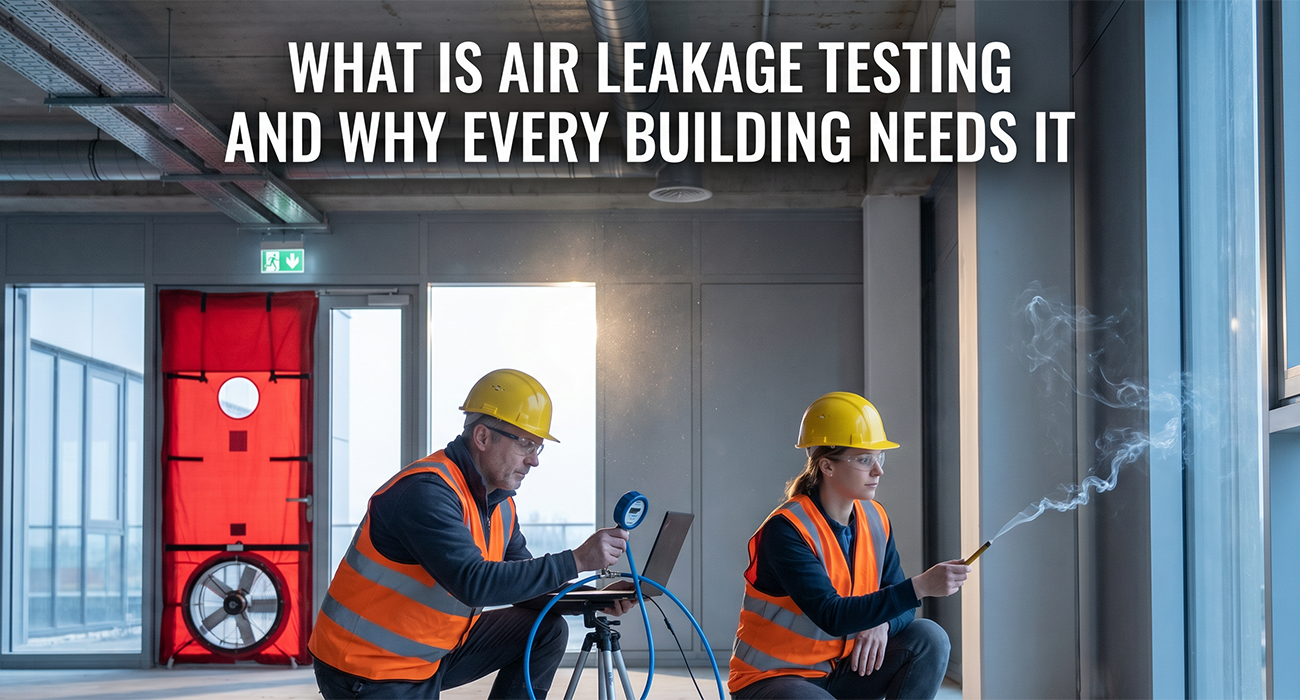
Air leakage testing is a structured inspection and measurement process that quantifies the rate at which air passes through unintended gaps in a building’s envelope — meaning its walls, roof, floor, windows, doors, and all penetrations. The most widely used method is the blower door test, which involves mounting a calibrated fan into a door or window opening, sealing all intentional openings (like vents), and then pressurizing or depressurizing the building to a standard reference pressure, typically 50 Pascals. By measuring the airflow required to maintain that pressure difference, technicians can calculate the building’s air permeability — usually expressed as a rate of air changes per hour (ACH50) or cubic meters per hour per square meter of building envelope.
The resulting data tells building professionals exactly how leaky the structure is. A higher number indicates more air is escaping, while a lower number reflects a tighter, better-performing envelope. For new buildings in many jurisdictions, there are minimum airtightness thresholds that must be met before a certificate of occupancy or green building credit can be awarded. Air leakage testing therefore plays a direct role in regulatory compliance, energy performance, and certification readiness.
How the Blower Door Test Works in Practice
During a professional air leakage testing exercise, a certified technician will begin by preparing the building for assessment. All mechanical ventilation openings, fireplaces, letterbox slots, and any other deliberate ventilation paths are temporarily sealed. The blower door fan is installed in a pre-selected doorway with an airtight frame and flexible panel. The fan is then ramped up to create the target pressure differential, and sensitive gauges measure both the pressure and the airflow passing through the fan.
Modern blower door equipment is highly calibrated and can detect very small levels of leakage. In addition to measuring the overall leakage rate, technicians often use complementary methods during the same visit to locate specific leak points. Thermal imaging cameras, for example, reveal temperature anomalies at crack locations — cold spots in winter or warm spots in summer that indicate where outside air is infiltrating. Smoke pencils or smoke generators can also be used to visually trace airflows through gaps in real time. Together, these methods give building owners a detailed, actionable picture of where their envelope is failing and by how much.
Key Standards and Benchmarks Governing Air Leakage Testing
For air leakage testing to be meaningful, it must be conducted in accordance with recognized standards. Several international and regional frameworks govern how tests should be performed, reported, and interpreted. ISO 9972 (formerly EN 13829) is a widely referenced standard that specifies methods for measuring building air permeability using fan pressurization. ASTM E1827 provides additional guidance on procedures and equipment. ATTMA TSL1 through TSL4 guidelines categorize buildings from high leakage to extremely low leakage based on complexity and use type.
In the GCC region, air leakage testing results feed directly into green building certification schemes that govern construction across the UAE and neighboring countries. These include the UAE’s Estidama Pearl Rating System, Dubai Green Building Regulations, EHS-Trakhees requirements, and RAK Municipality’s Barjeel framework. Saudi Arabia’s Mostadam certification, Qatar’s QSAS (Qatar Sustainability Assessment System), Kuwait Green Building Council guidelines, Oman Green Building Council standards, and Bahrain’s own green building requirements all place value on demonstrable building airtightness. Internationally, LEED and BREEAM both offer credit points for buildings that undergo and pass formal air leakage testing to meet defined thresholds.
The Role of Air Leakage Testing in Energy Efficiency
One of the most compelling arguments for conducting air leakage testing is its direct connection to energy performance. Buildings that leak air significantly increase the workload on their heating and cooling systems. When conditioned indoor air escapes continuously, the HVAC system must work harder and run longer to maintain the set temperature. In the UAE and broader Middle East, where air conditioning can account for up to 70% of a building’s total energy consumption, reducing air leakage is one of the most impactful efficiency interventions available.
Research consistently shows that buildings found to be leaky during air leakage testing and subsequently sealed can achieve energy savings of 10% to 30% depending on the severity of the original leakage. For large commercial buildings and multi-story towers, this translates to hundreds of thousands of dirhams saved annually. Equally important, reducing unnecessary HVAC load extends the operational lifespan of equipment and reduces maintenance costs. In this way, the modest investment in professional air leakage testing delivers a return that compounds year after year throughout a building’s operational life.
Impact on Indoor Air Quality and Occupant Comfort
Energy is not the only consideration. The quality of the indoor environment — including temperature consistency, humidity levels, and freedom from airborne contaminants — is profoundly affected by the airtightness of the building envelope. When air leakage testing reveals significant infiltration pathways, it is not just conditioned air that is being lost. Outdoor pollutants, fine dust particles, traffic-related fumes, and biological contaminants like mold spores and pollen can all enter through the same gaps.
In commercial buildings, hospitals, schools, and high-end residential towers, maintaining a controlled indoor environment is essential both for legal compliance and for the wellbeing of occupants. Buildings with poor envelope performance tend to have more variable temperatures in different zones, greater humidity fluctuations, and higher particulate loads in the air. Air leakage testing provides the evidence base needed to address these problems systematically, rather than through guesswork or piecemeal repairs that may miss the root causes.
Protecting the Building Structure Itself
Beyond energy and comfort, air leakage testing plays a vital role in protecting the physical integrity of the building structure. When warm, humid air infiltrates through the envelope and meets cooler surfaces inside the building, it can condense. This moisture accumulates in wall cavities, insulation layers, around window frames, and in ceiling assemblies. Over time, persistent moisture leads to mold growth, corrosion of metal components, decay of timber elements, and degradation of insulation materials. The structural consequences can be severe and costly to remediate.
By identifying air leakage pathways early — ideally during construction or immediately after handover — building owners can seal these gaps before moisture damage has a chance to develop. Remedial sealing work is far less expensive at this stage than it would be after mold has established itself behind cladding or within wall systems. In this sense, air leakage testing functions as a form of preventive maintenance for the building fabric itself, extending service life and protecting the long-term value of the asset.
When Should Air Leakage Testing Be Conducted?
The most effective time to carry out air leakage testing on a new building is during the construction phase, before finishes are applied. At this stage, if the test reveals problem areas, remedial sealing work can be done quickly and inexpensively while the structure is still accessible. Many project teams now schedule interim air leakage testing at multiple construction milestones — once the airtight layer is installed but before it is covered by finishes — to verify workmanship before it is too late to correct.
For existing buildings, air leakage testing is equally valuable. Whether triggered by energy audit findings, renovation planning, green building certification pursuits, or tenant complaints about comfort, a professional test provides objective data that informs every subsequent decision. Buildings undergoing major refurbishment or façade replacement are particularly good candidates, as the works create an opportunity to improve airtightness along with other performance upgrades. Facility managers who want to benchmark their portfolio against regulatory requirements or sustainability targets will also find air leakage testing an indispensable diagnostic tool.
Cornerstone Middle East: The Trusted Partner for Air Leakage Testing in the UAE and GCC
When it comes to professional air leakage testing in the UAE and the wider GCC region, Cornerstone Middle East has established itself as a leading authority. Based in Dubai and operating across Qatar, Saudi Arabia, Oman, Kuwait, and Bahrain, Cornerstone Middle East brings together ATTMA Level 2 certified air leakage testers and ITC Level 2 certified thermographers — credentials that ensure every test is conducted to the highest professional standard.
Cornerstone Middle East offers comprehensive air leakage testing that goes well beyond placing a fan in a doorway. Their approach integrates blower door testing with high-resolution thermal imaging and smoke-based leak detection to produce a complete picture of building envelope performance. Every engagement concludes with a detailed technical report that outlines findings, compliance status against applicable local and international standards, and specific recommendations for improvement. This level of rigor ensures that clients receive actionable intelligence rather than just a pass or fail number.
As a full-service building performance partner, Cornerstone Middle East also provides related services including building envelope commissioning, water infiltration studies, acoustic testing, curtain wall testing, smoke and gas ingress testing, and GASP (Gas-Sensing Particle) testing. This breadth of capability means that air leakage testing can be conducted as part of a holistic building performance assessment rather than in isolation, giving clients a comprehensive view of envelope integrity from a single trusted provider.
Cornerstone Middle East’s work supports compliance with UAE’s Estidama, Dubai Green Building Code, and EHS-Trakhees requirements, as well as international certifications including LEED and BREEAM. Their portfolio spans residential towers, commercial developments, government buildings, healthcare facilities, and large-scale infrastructure projects across the GCC, making them one of the most experienced teams in the region for this specialized work.
Making the Right Decision for Your Building
The decision to invest in air leakage testing is ultimately a decision to take building performance seriously. In a region where energy costs, sustainability regulations, and occupant expectations are all rising simultaneously, the buildings that succeed will be those whose owners and operators have made evidence-based decisions about performance. A professional air leakage testing exercise provides exactly the kind of evidence needed — precise, standardized, and independently verified — to drive meaningful improvements.
Whether you are a developer wanting to certify a new tower, a facility manager looking to reduce energy spend, a contractor needing to demonstrate compliance, or a building owner concerned about occupant comfort and asset longevity, air leakage testing delivers insights that no other diagnostic method can match. And with specialists like Cornerstone Middle East available to provide rigorous, certified assessments across the UAE and GCC, there is no reason to leave your building’s performance to guesswork.
Conclusion
Air leakage is one of the most underestimated threats to building performance, occupant well-being, and long-term asset value — yet it is also one of the most measurable and correctable. Through professional air leakage testing, building owners and managers gain a clear, data-driven understanding of exactly where their envelope is failing, how severely, and what it is costing them in energy, comfort, and structural integrity. It is not an optional exercise for forward-thinking buildings in the UAE and GCC — it is a professional responsibility.
From the earliest stages of construction to the ongoing management of existing assets, scheduling a certified air leakage testing assessment is one of the smartest investments a building stakeholder can make. The data gathered informs smarter retrofits, supports green building certifications, satisfies regulatory requirements, and ultimately delivers a safer, more efficient, and more comfortable building for everyone who occupies it. With trusted experts like Cornerstone Middle East available across the UAE and wider GCC region, accessing world-class air leakage testing has never been more straightforward. The question is not whether your building needs it — the question is how soon you will act on it.
Contact Cornerstone Middle East today at www.cornerstonemiddleeast.com to learn more about their air leakage testing services and schedule a consultation for your project.


Post a comment