


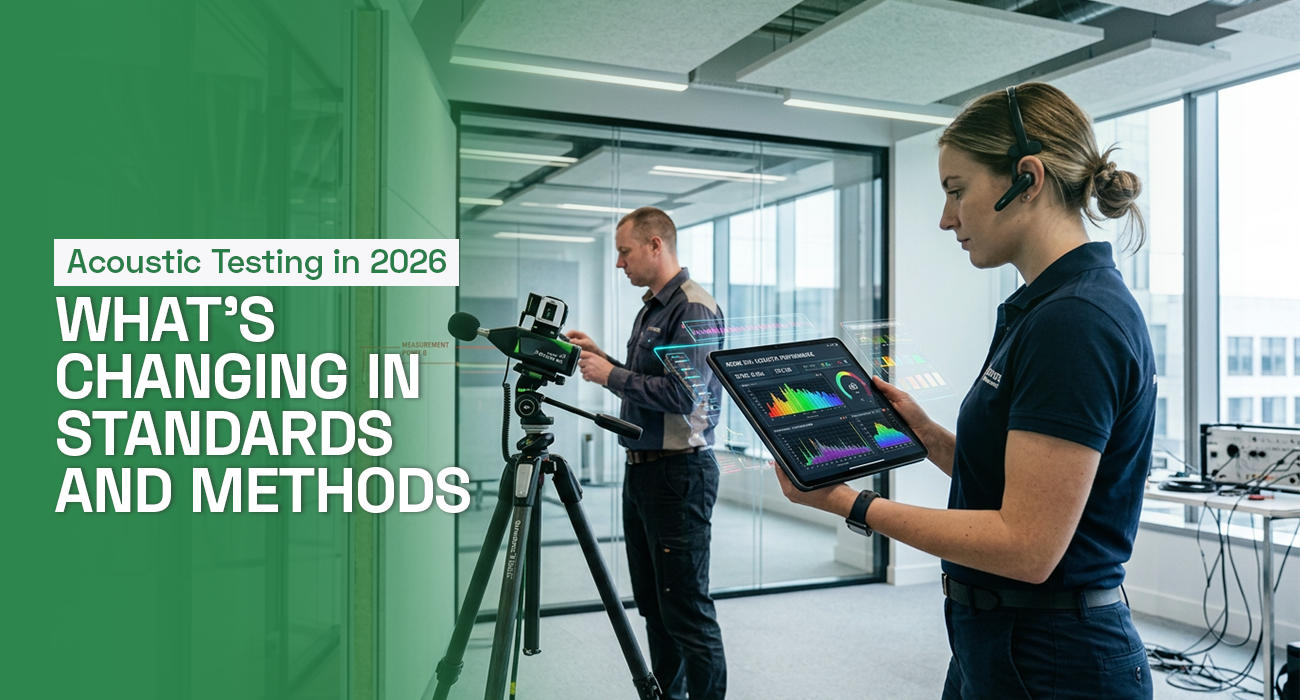
Acoustic Testing in 2026: What’s Changing in Standards and Methods
Noise has quietly become one of the most closely regulated aspects of modern construction. As cities across the UAE, GCC, and wider MENA region grow denser and buildings grow taller, the gap between comfortable living and constant disturbance often comes down to a few decibels. This is where acoustic testing steps in, giving developers, consultants, and facility owners a reliable way to measure, document, and control sound performance before it becomes a costly problem after handover.
2026 is proving to be a turning point for this field. Building codes are tightening, green building certifications are placing greater weight on occupant comfort, and clients are asking sharper questions about sound insulation long before a project reaches its final inspection stage. For companies operating in the testing and inspection space, understanding these shifts is no longer optional. It is becoming a core part of how buildings are designed, verified, and handed over.
This growing attention to sound performance is not limited to any single building type. Residential towers, hotels, hospitals, schools, and commercial offices are all being evaluated with more scrutiny than in previous years, and the professionals responsible for verifying these buildings need to keep pace with a fast-moving regulatory landscape. What used to be a fairly narrow, specialist discipline is now touching nearly every major construction project across the region.
Why Acoustic Testing Matters More Than Ever
Sound problems are rarely visible during construction. A wall may look complete, a floor slab may appear structurally sound, and a window may seem perfectly sealed, yet none of that guarantees the space behind it will feel quiet. Acoustic testing exists precisely because visual inspection cannot tell the whole story. It measures how sound actually travels through walls, floors, ceilings, and building envelopes, giving an objective, data-backed picture of performance.
This matters for several practical reasons. Hospitals need controlled sound environments to support patient recovery. Hotels and residential towers need privacy between units to protect guest and resident satisfaction. Offices need speech privacy for confidential conversations and open-plan comfort. Schools need classrooms where teachers do not have to compete with hallway noise. In every one of these cases, this type of testing provides the evidence that a building meets the standard it was designed to meet, rather than simply assuming it does.
As sustainability certifications such as LEED, BREEAM, Estidama, and various GCC green building codes continue to expand their scope, acoustic performance is increasingly treated as a measurable comfort criterion rather than an afterthought. This shift is pushing consultants and contractors to plan for these assessments earlier in the project timeline, rather than treating them as a last-minute compliance check.
Key Standards Being Updated in 2026
Several international and regional standards that govern building acoustics are undergoing meaningful revisions this year. While specific clauses vary by jurisdiction, a few broad trends are visible across most updated frameworks.
- Sound insulation criteria for party walls and floors are being tightened, particularly for multi-family residential buildings where airborne and impact noise transmission has historically been a common complaint.
- Field measurement protocols are being harmonized more closely with laboratory testing conditions, reducing the gap between how a material performs on paper and how it performs once installed on site.
- Reverberation time requirements for commercial and institutional spaces are being refined to reflect updated occupant comfort research, especially in healthcare and education facilities.
- Facade and envelope acoustic performance is receiving more attention as urban traffic noise and construction activity noise continue to rise in fast-growing GCC cities.
- Reporting formats are becoming more standardized, making it easier for regulators, consultants, and building owners to compare results across projects and regions.
These changes are not happening in isolation. They reflect a broader movement toward evidence-based building performance, where sound insulation verification sits alongside air leakage testing, thermal performance testing, and water penetration testing as part of a holistic building verification process.
How Testing Methods Are Evolving
The way acoustic testing is conducted has also changed considerably in recent years, and 2026 is accelerating several of these developments further.
Traditional field testing relied heavily on manual measurement with handheld sound level meters and a fair amount of interpretation from the technician conducting the survey. While skilled professionals can still produce accurate results this way, the industry is moving toward more automated and repeatable approaches. Digital sound level meters with built-in data logging, remote monitoring capability, and automated calibration checks are becoming standard equipment on site, reducing the margin for human error and making it easier to produce defensible reports.
Another significant shift is the growing use of intensity-based measurement techniques alongside traditional pressure-based methods. Sound intensity measurement allows technicians to isolate specific noise sources more precisely, which is particularly useful in mechanical rooms, HVAC plant areas, and facades exposed to multiple simultaneous noise sources such as traffic and construction activity. This precision matters when a building owner needs to know exactly which component or junction is responsible for a compliance failure, rather than simply knowing that a failure exists.
Impact sound testing methods are also becoming more sophisticated. Standardized tapping machines remain the primary tool for measuring impact noise transmission through floors, but calibration requirements and repeat-measurement protocols are being tightened to ensure consistency between different testing teams and different projects. This is especially relevant for residential towers and mixed-use developments, where floor-to-floor noise complaints are among the most common post-handover issues reported by occupants.
Facade sound insulation testing, which measures how effectively a building envelope blocks external noise, is seeing increased demand as well. With airport-adjacent developments, highway-facing towers, and dense urban infill projects becoming more common across the GCC, developers are commissioning these facade evaluations on mock-ups earlier in the design phase, well before full-scale construction begins. This proactive approach allows design teams to adjust glazing specifications, sealant details, and framing systems before the cost of correction becomes significant.
What This Means for Contractors and Consultants
For contractors, consultants, and facility management teams, these evolving standards and methods carry real practical implications. Projects that once treated acoustic performance as a secondary concern are now expected to demonstrate compliance with the same rigor applied to structural or fire safety requirements. This means sound performance verification needs to be scheduled at the right stages of construction, not only at final handover, so that any deficiencies can be identified and corrected while remediation is still straightforward and affordable. Waiting until a building is fully finished before checking wall assemblies or floor systems often means the fix involves reopening finished spaces, which is far more disruptive and expensive than catching the same issue during the framing or first-fix stage.
It also means documentation standards are rising. Regulators and certification bodies increasingly expect detailed, standardized reports that clearly show test methodology, equipment calibration records, environmental conditions during testing, and a transparent comparison against the applicable code threshold. Vague or incomplete reporting is far less likely to be accepted than it may have been a few years ago.
For developers pursuing green building certification, sound performance verification has become one of several interconnected performance checks that feed into a broader building verification strategy. Air tightness, water penetration resistance, HVAC balancing, and acoustic performance are increasingly assessed together, since they all directly affect occupant comfort and long-term building durability.
How Cornerstone Middle East Supports Acoustic Testing Needs
This is where an experienced testing and inspection partner becomes valuable. Cornerstone Middle East works with contractors, consultants, and facility teams across the UAE, GCC, and wider MENA region to deliver building performance verification that goes beyond a simple checklist. The company’s approach to acoustic testing reflects the broader philosophy behind its specialized testing services, which combine advanced equipment with practical, field-tested expertise.
Rather than treating acoustic testing as an isolated task, Cornerstone Middle East positions it within a wider framework of building performance services, alongside air leakage testing, water penetration testing, and building envelope integrity assessments. This integrated approach reflects how modern standards actually work, since most current codes and certification schemes evaluate a building’s comfort and durability as a combination of several interrelated factors rather than one isolated metric.
Working with a partner who understands both the regulatory landscape and the technical execution of acoustic testing allows project teams to move forward with confidence. It reduces the risk of late-stage surprises, supports smoother certification processes, and ultimately helps ensure that a finished building performs the way it was designed to, rather than simply looking finished on paper.
Looking Ahead
The direction is clear. As building codes tighten and occupant expectations rise, acoustic testing will continue to move from a specialized, occasionally requested service toward a standard, expected part of the building verification process. Contractors and developers who plan for it early, rather than treating it as a final checkbox, are likely to see fewer disputes, smoother handovers, and better long-term satisfaction from building occupants.
For anyone managing a project where sound performance matters, whether a hospital, a residential tower, an office building, or a mixed-use development facing a busy road, working with an experienced testing and inspection provider like Cornerstone Middle East offers a practical way to stay ahead of these evolving standards rather than reacting to them after the fact.


Post a comment