


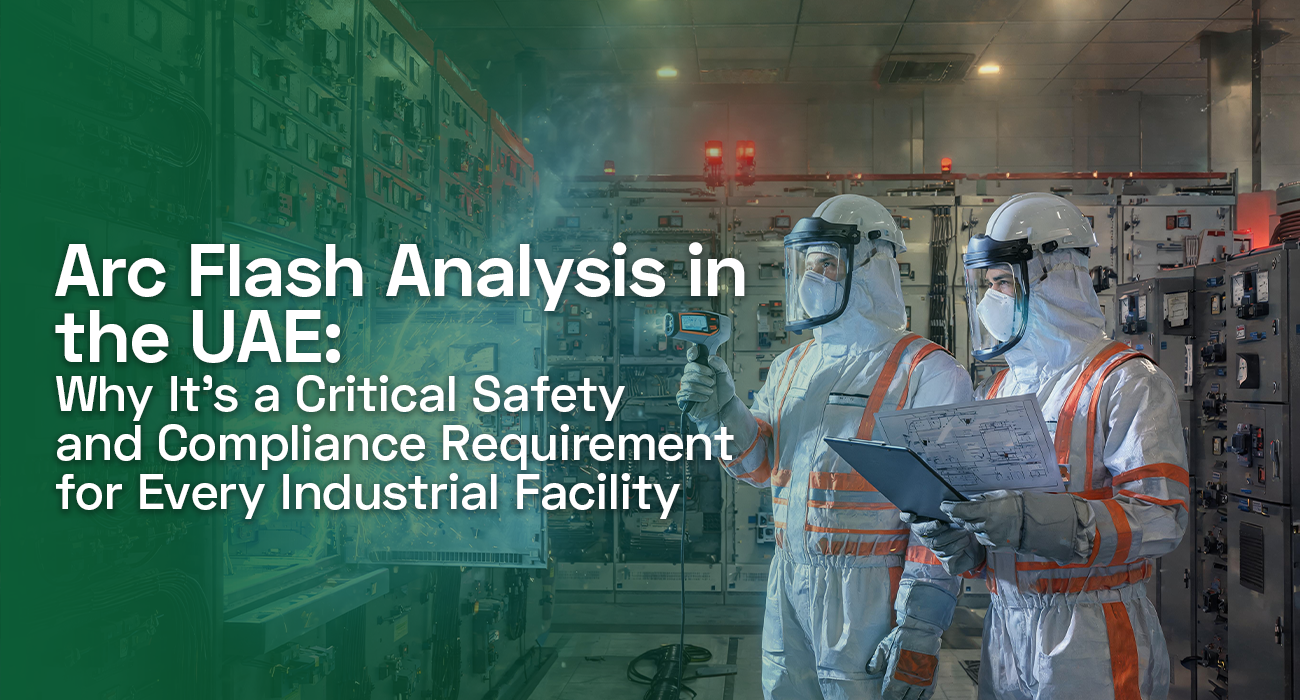
Arc Flash Analysis in the UAE: Why It’s a Critical Safety and Compliance Requirement for Every Industrial Facility
What Is Arc Flash Analysis And Why Should Every UAE Facility Manager Care?
In the world of industrial electrical safety, few hazards are as sudden, violent, or catastrophic as an arc flash. Yet despite the well-documented risks, arc flash analysis remains one of the most overlooked electrical safety obligations across factories, commercial buildings, oil and gas facilities, and MEP projects throughout the UAE.
An arc flash occurs when electrical energy travels through ionised air between conductors or between a conductor and ground. The resulting explosion releases a tremendous burst of energy in the form of intense heat, blinding light, pressure waves, and molten metal. Temperatures at the arc point can exceed 20,000°C roughly four times the surface temperature of the sun. Workers in the vicinity, if unprotected, face severe burns, hearing loss, blindness, and fatal injuries often within milliseconds.
Arc flash analysis, also called an arc flash hazard analysis or arc flash study, is the engineering process used to quantify this risk, determine the energy levels present in electrical equipment, and prescribe the correct protective measures. It is not merely a best-practice recommendation; for many UAE facilities operating under international standards, it is a compliance obligation.
The Regulatory and Standards Landscape in the UAE
The UAE’s electrical safety framework draws heavily from international standards, and facilities operating in free zones, industrial areas, and the oil and gas sector are often contractually required to demonstrate compliance with global benchmarks.
The two most widely referenced standards for arc flash analysis in the UAE are:
NFPA 70E (Standard for Electrical Safety in the Workplace) Published by the National Fire Protection Association, NFPA 70E provides the most comprehensive framework for arc flash hazard analysis, establishing incident energy thresholds, arc flash boundaries, and PPE (Personal Protective Equipment) category requirements.
IEEE 1584 (Guide for Performing Arc Flash Hazard Calculations) This is the engineering calculation standard behind the numbers. IEEE 1584 provides the mathematical models used to calculate incident energy and arc flash boundaries based on system parameters such as voltage, fault current, electrode configuration, and working distance.
In addition, facilities operating in Abu Dhabi and Dubai increasingly reference DEWA (Dubai Electricity and Water Authority) and ADDC (Abu Dhabi Distribution Company) compliance frameworks, which emphasise safe working procedures on energised equipment. Large-scale industrial and petrochemical projects aligned with ADNOC, DAFZA, JAFZA, and other free zone authorities are typically expected to demonstrate arc flash risk assessments as part of their HSE management systems.
Who Needs an Arc Flash Study in the UAE?
If your facility has electrical equipment operating at 50V or above and most industrial and commercial facilities certainly do an arc flash analysis should be on your safety agenda. The following sectors in the UAE have the most urgent need:
Oil and Gas Companies: Offshore platforms, refineries, petrochemical plants, and pipelines operate high-voltage switchgear and motor control centres under hazardous conditions. An arc flash incident in such an environment can trigger secondary explosions with devastating consequences.
Manufacturing and Industrial Factories: Production lines, CNC machinery, and high-power motor systems present elevated arc flash risk, particularly during maintenance activities and equipment commissioning.
Commercial and High-Rise Buildings: Main distribution boards, sub-distribution panels, and transformer rooms in commercial towers and shopping malls require periodic maintenance by qualified electrical teams activities that demand arc flash hazard awareness.
Data Centres and Critical Infrastructure: Uptime-critical facilities rely on redundant electrical systems, meaning live work on energised equipment is often unavoidable. Arc flash analysis defines the conditions under which this work can be safely performed.
MEP Contractors: Engineers and contractors working on new builds and fit-outs need arc flash data before energising systems, both for their own safety and to hand over complete, compliant documentation to the client.
Hospitals and Healthcare Facilities: Life-safety systems demand continuous power, and maintenance staff must work confidently around energised equipment. Arc flash studies protect both personnel and critical patient care systems.
How Is an Arc Flash Analysis Conducted? A Step-by-Step Overview
A professional arc flash study is a structured engineering process that typically unfolds across several stages. Here is what to expect when you engage a qualified testing and inspections team:
1. Data Collection and Site Survey
Engineers conduct a thorough site survey to gather single-line diagram information, equipment nameplate data, cable sizes, transformer ratings, and utility fault current data. This may involve physical inspection of switchgear, motor control centres (MCCs), panelboards, and distribution boards across your facility.
Accuracy at this stage is critical outdated or incorrect single-line diagrams are one of the most common reasons arc flash studies fail to reflect real-world conditions.
2. Power System Modelling
The collected data is entered into specialised power system analysis software (such as ETAP, SKM PowerTools, or EasyPower) to build a complete model of your electrical distribution network. This model allows engineers to perform short circuit analysis and protective device coordination studies, which form the foundation of the arc flash calculations.
3. Short Circuit and Protective Device Coordination Analysis
Before calculating arc flash incident energy, engineers must understand how much fault current flows during a bolted fault and how quickly the upstream protective device (circuit breaker or fuse) will interrupt it. The clearing time of the protective device directly influences the incident energy at the point of work faster interruption means lower energy release.
4. Incident Energy Calculations (IEEE 1584)
Using the IEEE 1584 calculation methodology, engineers determine the incident energy measured in calories per square centimetre (cal/cm²) at each piece of equipment where live electrical work may be performed. From this, they establish the arc flash boundary (the distance within which unprotected workers could sustain second-degree burns) and the required PPE category.
5. Labelling and Documentation
Every piece of equipment receives an arc flash warning label displaying the incident energy level, arc flash boundary, required PPE category, and restricted approach boundaries. This label becomes the frontline safety tool for every maintenance technician who opens that panel.
6. Recommendations and Mitigation
A thorough arc flash study doesn’t just calculate risk it also identifies opportunities to reduce it. Engineers may recommend adjustments to protective device settings, the installation of current-limiting fuses, or the introduction of zone-selective interlocking to lower incident energy levels to safer thresholds.
Understanding Arc Flash Boundaries and PPE Categories
One of the most actionable outputs of an arc flash analysis is the definition of hazard boundaries and the specification of appropriate PPE. Under NFPA 70E, there are three key boundaries:
Limited Approach Boundary The distance within which only qualified electrical workers may approach without special precautions.
Restricted Approach Boundary Closer still, this is the zone where the risk of electric shock becomes significant. Entry requires insulated tools, rubber gloves, and face protection.
Arc Flash Boundary The distance from the arc source at which a worker could receive a second-degree burn if unprotected. Everyone inside this boundary must wear appropriate arc-rated PPE.
PPE categories range from Category 1 (minimum 4 cal/cm² arc rating) for lower-energy tasks to Category 4 (minimum 40 cal/cm²) for work on high-energy systems such as high-voltage switchgear. Wearing incorrect or insufficient PPE even a simple cotton shirt instead of arc-rated clothing can mean the difference between a minor incident and a life-altering injury.
How Often Should Arc Flash Analysis Be Updated?
An arc flash study is not a once-and-done exercise. IEEE 1584 and NFPA 70E recommend reviewing and updating the study whenever:
- Changes are made to the electrical distribution system (new feeders, transformer upgrades, additional loads)
- The utility supply characteristics change
- Protective device settings are modified
- Major equipment is replaced or relocated
- A significant period has elapsed (typically every 5 years is considered best practice)
In practice, many UAE facilities we encounter have either never conducted an arc flash study or are working from outdated reports that no longer reflect the current state of their electrical systems. Both situations present unacceptable safety and liability risks.
The Business Case: Beyond Compliance
While regulatory compliance is a compelling reason to commission an arc flash study, the business case extends well beyond avoiding fines or satisfying audit requirements.
Worker Protection: The most direct benefit is keeping your electrical maintenance team safe. Burns from arc flash incidents are among the most severe and costly workplace injuries, with recovery times measured in months and permanent disability outcomes not uncommon.
Asset Protection: An arc flash event can destroy switchgear, MCCs, and transformers worth hundreds of thousands of dirhams. A properly coordinated protection system informed by the arc flash study minimises equipment damage through faster fault interruption.
Operational Continuity: Unplanned electrical outages triggered by arc flash events can halt production for days. For manufacturers, logistics companies, and data centres, the financial cost of downtime far exceeds the cost of the study itself.
Insurance and Legal Liability: In the event of an incident, the absence of a documented arc flash assessment exposes your organisation to significant legal liability. Conversely, demonstrating a proactive safety programme strengthens your position with insurers and regulators alike.
Choosing the Right Arc Flash Analysis Provider in the UAE
Not all testing and inspection companies offer the depth of expertise required for a credible arc flash study. When selecting a provider, look for the following:
- Qualified engineers with recognised credentials (such as Certified Electrical Safety Compliance Professional CESCP, or equivalent)
- Experience with IEEE 1584-2018 (the latest version of the standard)
- Proficiency with industry-standard software (ETAP, EasyPower, SKM)
- A track record of completed studies across relevant sectors in the UAE
- The ability to deliver not just the study, but also PPE procurement guidance, training, and ongoing maintenance support
A professional arc flash analysis should deliver a complete, actionable report not just a set of numbers. Your team should walk away with clear labelling, an updated single-line diagram, defined safe work procedures, and a PPE programme tailored to your facility.
Take the First Step Toward a Safer Facility
Arc flash analysis is one of the most impactful investments you can make in the safety, compliance, and resilience of your electrical systems. Whether you manage a refinery in Abu Dhabi, a manufacturing plant in Sharjah, a high-rise development in Dubai, or a critical infrastructure facility anywhere across the UAE, the risks are real and the solutions are well within reach.
Our team of qualified electrical engineers and safety professionals delivers comprehensive arc flash studies, power system analysis, and protective device coordination services to industrial and commercial clients across the UAE. We work to international standards, provide fully documented reports, and support your team through implementation and beyond.
Contact us today to schedule a site assessment and take the first step toward a fully compliant, arc-flash-safe electrical environment.


Post a comment