

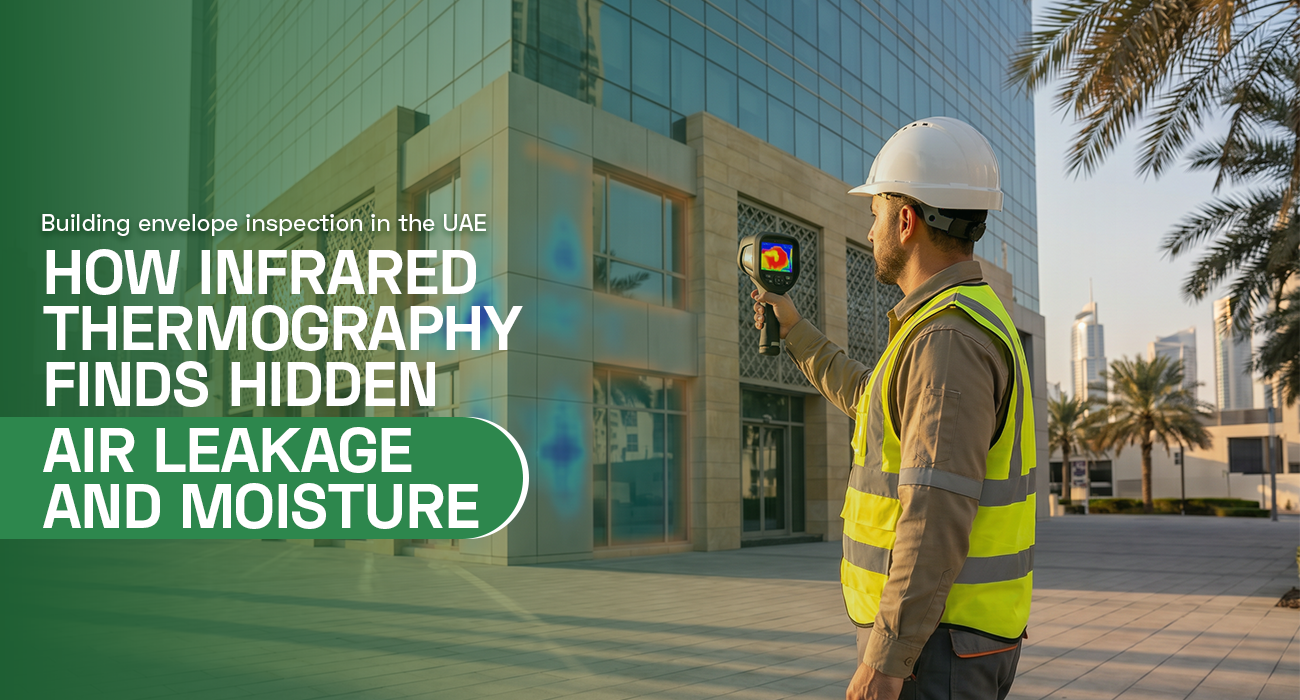
Building envelope inspection in the UAE: how infrared thermography finds hidden air leakage and moisture
Building envelope inspection is one of the highest-value checks an owner or developer can run on a tower in the UAE, and it is also one of the most overlooked. Picture a new commercial building in Dubai or Abu Dhabi that meets every visible standard at handover, yet within the first year the cooling bills run higher than projected, tenants complain of hot spots near the glazing, and faint staining appears inside the curtain wall. None of it is visible to the naked eye. All of it points to the same place: the building envelope.
In a documented international case, a building owner began noticing flies entering a newly built commercial property at the start of the first heating season. The investigation traced the cause to excessive air leakage at the top of several curtain wall assemblies, a defect invisible to the eye but obvious under infrared thermographic imaging. Left alone, that single flaw would have driven up energy costs, harmed indoor air quality, and slowly degraded the structure through trapped moisture. The same physics applies in reverse across the Gulf, where intense solar load, coastal humidity, and the constant pressure of powerful air conditioning push warm, moist air into cooled interiors.
At Cornerstone Middle East, we treat the envelope the way a thorough health screening treats the human body. You cannot correct what you have not properly diagnosed. The most powerful diagnostic tool available for this work is infrared thermography, supported by air leakage testing and building science expertise. This guide explains how facade thermal imaging works, what it can and cannot tell you, how UAE green building codes raise the stakes, and how to commission an envelope that performs the way it was designed to.
What is infrared thermography in building envelope inspection?
Infrared thermography is a technology that turns invisible heat radiation into a visible image. Every surface emits heat, and an infrared camera reads those emissions, translating temperature variations into colour-coded images called thermograms. Warmer areas appear in reds and yellows, cooler areas in blues and purples. The result is a thermal map of the building envelope that shows what is happening behind walls, around windows, and across facades, all without a single destructive opening.
Combined with other diagnostics, facade thermal imaging assesses the overall air leakage and thermal performance of an envelope. It detects heat loss by conduction, convection, and air movement, and it identifies moisture trapped within wall assemblies. For the large commercial and institutional buildings that define most projects in Dubai and Abu Dhabi, that capability is invaluable. A single deficiency that is easy to correct on a small building can repeat dozens or even hundreds of times across the facade of a tower, multiplying both the energy impact and the cost of putting it right.
What facade thermal imaging can detect
Applied correctly, infrared thermography reveals several distinct categories of envelope deficiency, each with its own thermal signature.
Conductive heat loss
This occurs where materials with high thermal conductivity create a direct pathway through the envelope. Steel structural elements, masonry shelf angles, and concrete connections are common culprits. In an air-conditioned UAE building they typically show as cold spots on exterior thermograms during the cooling season.
Convective heat loss
This produces a plume-like pattern rising from a point of weakness such as a poorly sealed window frame, driven by air moving through gaps rather than heat passing through solid material.
Air leakage
This is the most significant issue from both an energy and a durability standpoint. In the UAE, warm and humid outdoor air forcing its way into a cool interior can deposit moisture inside wall assemblies, leading to condensation, mould, and structural decay. Thermographic images taken while the building is held under a controlled pressure differential show exactly where air is escaping or infiltrating.
Moisture accumulation
Wet materials behave differently from dry ones in thermal mass and evaporation, so damp insulation, saturated masonry, and waterlogged cavities all register as distinct anomalies that an experienced thermographer can map.
The critical limitation: thermography cannot tell you why
Here is the caveat every owner, facilities manager, and developer must understand. Infrared thermography alone will not identify the cause or source of an anomaly. A thermogram shows that something is different. It does not explain why.
Consider a real example. An exterior thermogram of a curtain wall may show what looks like a serious defect, a hot spot suggesting air leakage or thermal bridging. Without proper interpretation, that anomaly might in fact be a benign interior heat source, a radiator, electrical panel, or piece of equipment sitting against the inside face of the wall. The camera faithfully records the temperature difference. It cannot tell you what is behind it. The reverse is just as dangerous. A genuine deficiency can be misread, or missed entirely, when the survey is run under the wrong conditions or by an under-qualified operator.
Proper interpretation calls for a full assessment of the building alongside a solid grasp of building science and the forces acting on the envelope. Wind, solar radiation, the indoor to outdoor temperature differential, building pressurisation, and the construction type all shape the thermal image. This is the line between a genuinely useful assessment and a misleading one, and it is why the expertise behind the camera matters as much as the camera itself.
Why large UAE buildings need a specialist approach
Residential inspections and large commercial or institutional assessments are fundamentally different undertakings. The scale, the complexity, and the building systems involved demand different expertise, different equipment, and a more rigorous methodology.
For large buildings, the qualifications of the person operating the camera are the single most determining factor in obtaining an accurate result. An excellent camera, used with the wrong settings and under inappropriate conditions, produces inaccurate and misleading findings. On a tower facade, one misjudged deficiency can be repeated across the entire elevation, with serious consequences for remediation budgets. A thorough understanding of building science and construction is a prerequisite. An accomplished roofing thermographer, for instance, does not automatically have the experience needed for a building envelope assessment. The skill sets are distinct, and the cost of misapplying them is high.
The conditions that make or break a thermographic survey
A thermographic inspection is only as good as the conditions under which it is conducted. The wrong conditions do not simply reduce accuracy, they can produce actively misleading results. Three factors must be managed with care.
Exterior conditions
Rain or even recent rainfall puts a physical barrier between the camera and the surface and can invalidate an exterior survey. Wind intensity and direction matter enormously for metal and glass curtain wall systems, which hold very little heat. A curtain wall scanned on a calm night gives far more reliable results than the same wall scanned during a windy afternoon. Direct solar radiation can mask or exaggerate thermal patterns, which is why exterior scanning in the UAE is usually carried out at night, after a minimum time lag past sunset and past any rainfall.
Interior conditions and pressurisation
Building pressurisation is the most important interior variable of all. Positive pressure pushes interior air outward through envelope defects, making exfiltration visible on exterior scans. Negative pressure draws exterior air inward, making infiltration visible on interior scans. Different deficiency types need different pressurisation strategies before they become detectable at all. Ideally pressurisation is controlled through the building’s own mechanical systems by balancing supply and exhaust. Older systems and residential towers often cannot achieve a uniform differential, and in those cases portable high-power equipment, large multi-fan blower door systems, creates the necessary conditions. Calibrated digital micro manometers measure and control the pressure, while portable weather stations monitor the external environment.
Camera and operator
The instrument must have the right wavelength range, thermal and spatial resolution, and temperature accuracy for the application, with a telephoto lens for tall exteriors and a wide-angle lens for interiors. Emissivity, viewing distance, temperature, and humidity settings must be calibrated before every inspection. On large buildings the survey should be videotaped and reviewed afterwards, with photographs of each area cross-referenced to the matching thermograms.
Air leakage testing: blower door systems and smoke testing
Infrared thermography performs best when paired with complementary diagnostics. Two of the most important are high-power blower door systems and portable smoke generators.
Blower door systems for large buildings are far more powerful than the units used in residential energy audits. A typical large-building system uses three to six high-power fans, capable of pressurising entire floors or, in some cases, a whole building at once. By holding a known pressure differential across the envelope, these systems force air through any gap or weakness, making the pathway both thermographically visible and quantitatively measurable. The resulting air leakage rates can then be compared against design specifications and applicable standards.
Smoke generators give a direct, visible way to locate and confirm specific leakage paths. When smoke is introduced into a pressurised building, it exfiltrates through openings in the envelope and makes the leakage immediately visible. In documented cases, smoke testing has confirmed excessive exfiltration at curtain wall weep holes, at the base of wall assemblies, and at the tops of curtain wall systems where airtightness details were poorly installed. These are precisely the locations where thermographic anomalies are most often noted, and where remediation matters most. Together, these tools turn a thermographic survey from a preliminary screening exercise into a complete diagnostic assessment that can support confident remediation decisions.
From observation to diagnosis: validating thermography results
Spotting an anomaly on a thermogram is only the beginning. The often neglected but critical next step is validation, confirming that what the camera revealed corresponds to a real deficiency and understanding the root cause well enough to define the right fix.
For some anomalies, validation is straightforward. An experienced thermographer can reference the architectural and engineering detail drawings to confirm that a thermal pattern matches a known detail, such as a shelf angle, a window head, or a parapet flashing, and judge whether the behaviour is acceptable or a genuine defect. For more complex cases, physical investigation is required. This can mean carefully dismantling interior finishes at a chosen location to expose the air barrier or insulation and confirm the leakage path directly. In some cases, dismantling part of the exterior facade is necessary to understand the extent of a deficiency. That work is more invasive and costly than thermography alone, but it is almost always far cheaper than launching a remediation programme based on an incomplete diagnosis.
Standards that make a building envelope inspection defensible
Quality thermographic commissioning does not happen in a vacuum. A professional framework of industry standards governs how assessments should be conducted, reported, and interpreted. Key references include the following.
- CAN/CGSB 149-GP-2MP: the Canadian standard for thermographic analysis of building enclosures, setting out methodology and reporting requirements.
- ASTM C1060: standard practice for thermographic inspection of insulation installations in the envelope cavities of frame buildings.
- ANSI/ASHRAE 101: application of infrared sensing devices to the assessment of building heat loss characteristics.
- ASTM E1186: standard practice for air leakage site detection in building envelopes and air barrier systems.
- ASTM E779: standard test method for determining air leakage rate by fan pressurisation.
Adherence to these standards is not a formality. It is the mechanism by which consistent, reliable, and defensible results are achieved. A report prepared in line with the applicable standards gives owners, developers, and authorities a credible and professionally accountable record of envelope performance, and it gives the findings standing in a commissioning or contractual context.
UAE green building codes and why envelope commissioning matters
The UAE has some of the most demanding building performance frameworks in the region, and they all place the envelope at the centre of energy and comfort outcomes. In Dubai, the Al Sa’fat Green Building Evaluation System and the Dubai Green Building Regulations and Specifications set thermal performance and energy targets for new buildings. In Abu Dhabi, the Estidama Pearl Rating System does the same, with envelope thermal performance and air-tightness contributing directly to a project’s rating.
These frameworks raise the bar on design. They do not, on their own, guarantee that the building as constructed actually meets the target. Connections get missed, sealants are applied poorly, and flashing details are omitted, and unlike a cracked tile these failures are invisible. Independent building envelope inspection, using infrared thermography and air leakage testing, is the most reliable way to confirm on site that the thermal and air-tightness performance promised on paper has actually been delivered. For developers it protects the rating and the investment. For owners and facilities teams it provides documented proof of performance at handover and a baseline for the years that follow.
Lessons from the field
Two examples from real building investigations show how the method works in practice.
In the first, a newly built commercial building was generating air leakage complaints within its first heating season. Thermographic analysis, conducted with the building held under positive pressure by its mechanical systems, revealed excessive air leakage at the top of multiple curtain wall assemblies. Smoke testing then confirmed and mapped the sources. Dismantling the top section of the curtain wall was ultimately required to establish and carry out the correct repair, a costly intervention but far less costly than years of undetected loss and damage.
In the second, a thermographic assessment carried out as part of the commissioning of a new building identified two separate problems: excessive air leakage through metal panelling below the curtain wall assemblies, and significant moisture accumulation within sections of the exterior masonry. The moisture finding was especially telling. A large portion of a masonry wall was holding water, a condition that in a Gulf coastal environment can accelerate corrosion of embedded structural steel and lead to serious long-term problems.
Building envelope inspection in the UAE: what owners should know
The regional climate adds specific dimensions that owners must appreciate. Extreme thermal loads, intense solar radiation, high ambient temperatures, and large day to night swings stress envelopes in ways that differ from the cold-climate scenarios most building science literature is written around. In hot and humid conditions, air leakage carries moist outdoor air into cooled interiors, sharply increasing latent cooling loads and risking condensation inside wall assemblies where warm humid air meets cool surfaces. That moisture can be as damaging as anything seen in a cold climate, and arguably more so, because it occurs unseen and can persist all year.
High-performance envelopes in the UAE must control not only conduction through the wall but also air infiltration and the moisture it transports. Curtain wall systems, which dominate the facades of towers across Dubai and Abu Dhabi, are particularly prone to leakage at joints, gaskets, and assembly interfaces, the very locations where thermographic commissioning has proven most valuable worldwide. Commissioning the envelope before handover, while access to the facade is still practical, is dramatically more cost-effective than retrofitting a finished building, and it gives every party documented evidence of how the building performed on the day it changed hands.
Frequently asked questions
What is a building envelope inspection?
A building envelope inspection assesses how well a building’s exterior shell, including walls, windows, curtain walls, and roofing, controls heat, air, and moisture. It typically combines infrared thermography, air leakage testing, and a building science review to find hidden defects before they cause energy loss, moisture damage, or comfort complaints.
How does infrared thermography detect air leakage?
When a building is held under a controlled pressure differential, air forced through gaps in the envelope changes the surface temperature around those gaps. An infrared camera captures these temperature differences as thermal patterns, revealing where air is leaking in or out. The pressure is usually created by the building’s own systems or by a high-power blower door.
When should a building envelope be inspected or commissioned?
The most cost-effective time is during construction and before handover, while access to the facade is still practical and defects can be corrected easily. Inspection is also valuable when investigating performance complaints in an existing building, or when planning a major facade remediation programme.
What is a blower door test on a large building?
A blower door test uses powerful fans to create a known pressure difference across the building envelope. On large buildings this requires multi-fan systems capable of pressurising whole floors or the entire building. The test forces air through any weakness, making leakage paths visible to thermography and measurable against standards and design specifications.
Is building envelope inspection required under UAE green building codes?
UAE frameworks such as Al Sa’fat in Dubai and the Estidama Pearl Rating System in Abu Dhabi set demanding thermal performance and energy targets for new buildings. Independent envelope inspection is the most reliable way to confirm that those targets are actually met on site, which protects both the project rating and the long-term performance of the asset.
Why is thermography in the UAE usually done at night?
Direct solar radiation heats facade surfaces and can mask or exaggerate the thermal patterns that matter, which makes daytime exterior scanning unreliable in the Gulf climate. Surveying after sunset, once surfaces have shed absorbed solar heat, gives a cleaner and more accurate picture of how the envelope is performing.
How much does a building envelope inspection cost in the UAE?
Cost depends on the size and height of the building, the facade systems involved, the scope of testing, and whether portable pressurisation equipment is needed. The most accurate way to budget is a short scoping conversation about your building and your goals.
Partner with Cornerstone Middle East
Infrared thermography, applied by qualified professionals under the right conditions and backed by air leakage testing and rigorous validation, is one of the most powerful technologies available for assessing a large building envelope. It surfaces air leakage, moisture, and thermal bridging that would otherwise stay hidden until they show up as occupant complaints, visible damage, or inflated energy bills.
But the technology is only as good as the expertise applied to its results. At Cornerstone Middle East, our building envelope commissioning practice combines advanced thermographic inspection with air leakage testing, smoke testing, and detailed building science analysis to give you a complete picture of how your envelope is performing across Dubai and Abu Dhabi. Whether you are commissioning a new development, investigating a performance complaint, or planning a major facade remediation, we bring the full diagnostic capability that large UAE buildings demand.
Your building’s envelope is its first line of defence. Make sure it is performing the way it should.


Post a comment