

Pipeline Rehabilitation in the UAE: Why Inspection Comes First
Sewer, drainage and stormwater networks are some of the most valuable assets a master developer, contractor or utility owns, and some of the hardest to see. A network laid ten or fifteen years ago may look fine from the surface while joints open up, pipes deform under load and sediment builds up inside. By the time the problem shows at ground level, as a blockage, a collapse or a sinking road, the repair is bigger, slower and far more expensive.
Pipeline rehabilitation exists to get ahead of that. But rehabilitation only works when it is based on an accurate picture of what is actually happening inside the pipe. That is why every rehabilitation programme should start with inspection.
Why UAE pipeline networks need attention
Underground networks in the UAE deal with a mix of conditions that wear them down faster than many people expect:
- Shifting sandy soils and settlement, especially in reclaimed and newly developed areas
- High groundwater and saline conditions near the coast
- Hydrogen sulphide in sewer networks, which attacks concrete pipes and manholes
- Heavy construction traffic over newly laid lines during the build phase
- Rapid community growth putting more flow through networks than they were sized for
Each of these causes a different kind of defect, which is why a single visual check is rarely enough to decide what repair is needed.
Inspection is the first step in rehabilitation
Before any repair method is chosen, the asset owner needs to know three things: what the defect is, exactly where it is, and how serious it is. The main inspection and survey methods we use to answer those questions are:
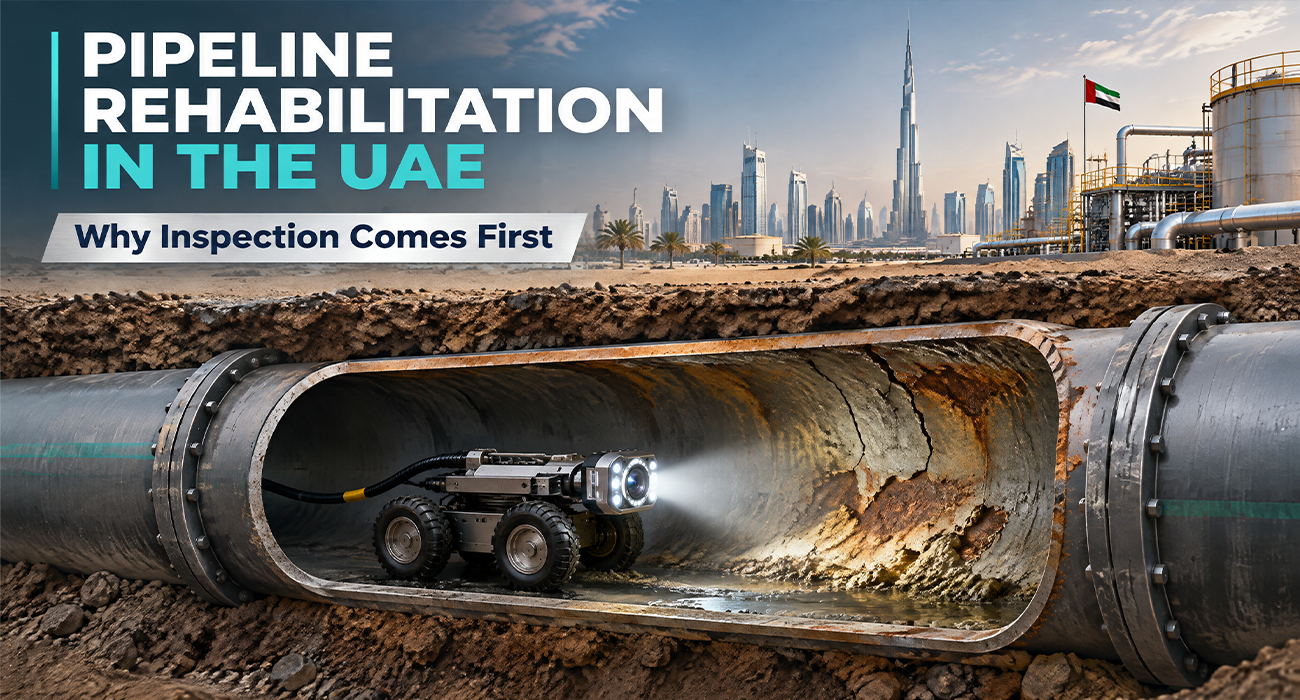
- CCTV pipeline inspection: a camera crawler travels through the line and records the internal condition, picking up cracks, displaced joints, root or debris intrusion, corrosion and blockages without excavation.
- Pipeline deflection survey: measures how far flexible pipes have deformed from their original shape, which matters for handover acceptance and for spotting lines at risk of failure.
- Pipeline inclination survey: checks gradient along the line to find sags and back-falls that trap sediment and reduce flow.
- Pipeline flushing and jetting: clears silt and debris so the line can be surveyed properly and returned to full capacity.
- Remote visual inspection: for chambers, shafts and confined spaces that are unsafe or impractical for people to enter.
Put together, these give a clear, coded condition record of the network, and that record is what the rehabilitation plan is built on.
Matching the repair to the defect
Once the condition is known, the repair can be targeted instead of guessed. Not every defect means replacing a pipe. In many cases a localised repair restores the line at a fraction of the cost and disruption of excavation:
- Pipeline patch repair: a no-dig repair for localised cracks, holes and joint defects, installed from inside the pipe.
- Manhole rehabilitation: restoring chambers damaged by corrosion, infiltration or structural wear, which are often where network problems start.
After repair, a follow-up CCTV inspection confirms the work is done properly and gives the asset owner a documented record for the file.
What this means for developers, contractors and utilities
For master developers and asset owners, regular inspection turns pipeline maintenance into a planned budget line instead of an emergency. Knowing the condition of the network also protects asset value and makes handover to authorities smoother.
For contractors, CCTV, deflection and inclination surveys are often required before a new network is accepted. Finding defects before handover is far cheaper than dealing with them during the defects liability period.
For utilities and facility management teams, condition data helps prioritise which lines to rehabilitate first, so limited budgets go where the risk is highest.
When to plan an inspection
Good times to schedule a pipeline survey include:
- Before handover of a new network to the client or authority
- Before the end of a defects liability period
- When taking over or acquiring an existing community or asset
- After nearby construction, piling or heavy traffic over the line
- When there are repeat blockages, slow flow, odours from chambers or surface settlement
- As part of a routine condition programme, typically every few years for critical lines
How Cornerstone supports pipeline rehabilitation
Cornerstone delivers pipeline and water services across the UAE, from inspection and surveys to cleaning and targeted repair. Because the same team handles the inspection, the cleaning and the repair, the findings carry straight through into the rehabilitation plan, and the client deals with one accountable partner instead of coordinating several.
Frequently asked questions
Do you need to dig to inspect a pipeline?
No. CCTV inspection is done through existing manholes and access points, so the line can be surveyed without excavation.
What is the difference between a deflection survey and an inclination survey?
A deflection survey measures how much a pipe has deformed from its original round shape. An inclination survey measures the gradient along the line. Both are commonly needed for handover of new networks.
Can damaged pipes be repaired without replacing them?
Often, yes. Localised cracks and joint defects can usually be fixed with a no-dig patch repair from inside the pipe, which avoids digging up roads and landscaping.
How often should a sewer or drainage network be inspected?
It depends on the age, material and criticality of the line. Critical or older lines are usually inspected every few years, and any network should be surveyed before handover and before the end of the defects liability period.
Why clean the pipe before inspection?
Silt and debris hide defects. Flushing and jetting first means the CCTV survey shows the true condition of the pipe.
Plan your pipeline inspection
Developer, contractor or utility planning a handover, a takeover or a rehabilitation programme? Contact Cornerstone to arrange a pipeline inspection and condition survey.


Post a comment