


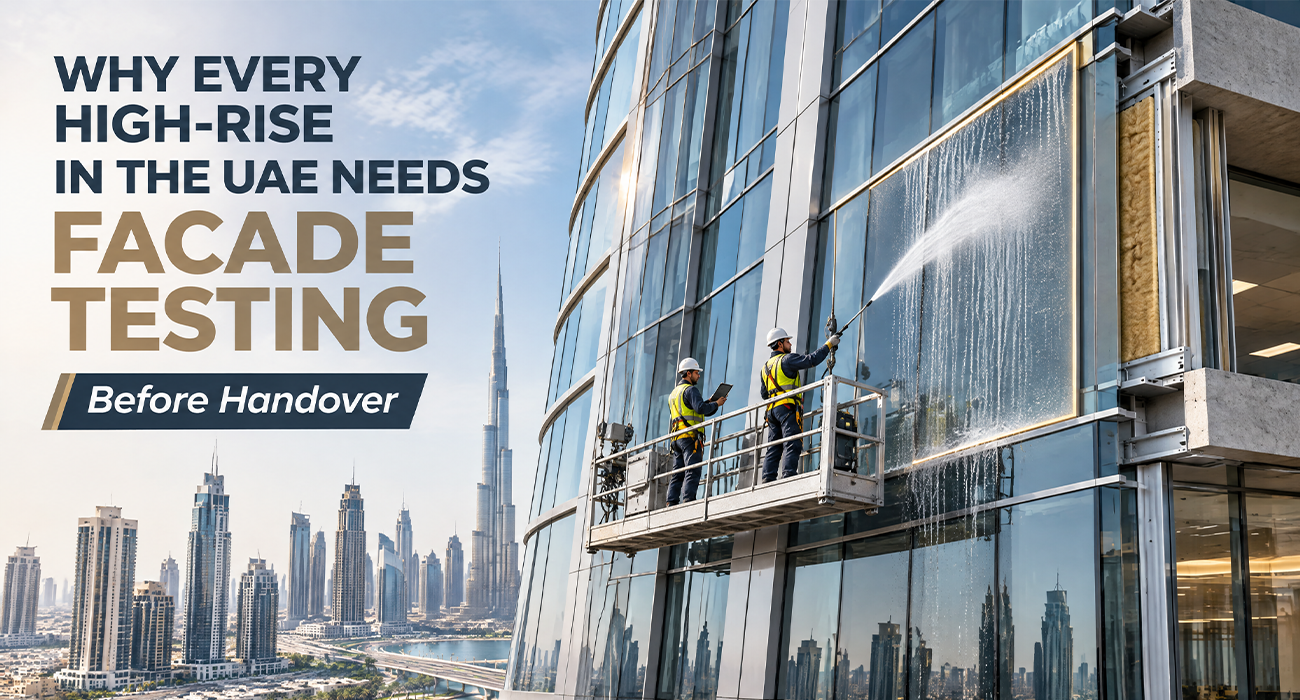
Why Every High-Rise in the UAE Needs Facade Testing Before Handover
Dubai’s skyline is full of glass towers and complex curtain wall systems. Behind the look of these buildings is a less visible process that decides whether they will actually perform for decades: facade testing. As projects across the UAE and GCC push architectural limits, checking that a building’s outer skin can handle wind, rain, heat and pressure matters more than ever.
Facade testing is the evaluation of a building’s exterior envelope to confirm it meets the design specification for water tightness, air tightness and structural performance. It is not one test but a set of procedures carried out at different stages of a project, from the mock-up stage through to on-site checks after installation. Without it, developers risk handing over buildings with leaks, drafts or weak fixings that may not show up until years later, when repairs are far more expensive and disruptive.
What facade testing actually involves
Many people assume facade testing is a single inspection at the end of a project. In practice it starts much earlier. The design is usually validated first on a full-scale mock-up, which is put through simulated rain and wind pressure. Once the design is proven, the same principles are applied on site to confirm the installed facade performs the way the mock-up did.
That matters because a facade can be engineered perfectly on paper and still fail if installation quality, sealant application or anchor placement is inconsistent. This is why testing is carried out at several checkpoints, not treated as a box to tick just before handover.
The main things evaluated during facade testing include:
- Water penetration resistance through joints, frames and sealant lines
- Air leakage, which affects both energy use and occupant comfort
- The strength of anchors, brackets and fixings holding facade panels in place
- Acoustic performance, especially near airports, highways and busy districts
- Smoke and gas ingress at junctions between floors and the facade
Why it matters more in the Gulf climate
The Gulf is a tough environment for any building envelope. Extreme summer heat, intense sun, occasional heavy rain and high coastal humidity all put the facade under stress. A curtain wall that performs well in a mild climate can behave very differently after years of thermal expansion and contraction in Dubai or Abu Dhabi.
This is why facade testing has become a standard requirement on major developments across the UAE, Saudi Arabia, Qatar, Bahrain, Oman and Kuwait. Consultants, authorities and green building frameworks increasingly expect independent proof that the envelope performs, rather than relying on the installing contractor’s own sign-off.
The core facade testing methods
Each test targets a different way a facade can fail, which is why one inspection is rarely enough.
Water testing. Site hose testing and spray rack testing simulate rain and wind-driven water on installed sections, finding weak points in sealant joints, window frames and panel junctions before they turn into leaks. Site chamber testing goes further by applying controlled pressure to replicate storm conditions on site.
Air leakage testing. Air leakage and blower door testing measures how much air passes through the envelope under controlled pressure. Leakage drives up cooling load and energy bills, so this is a key test for sustainability targets.
Anchor pull-out testing. Anchor pull-out testing checks that the anchors fixing facade panels to the structure can take their design loads. Anchor failure has serious safety consequences, so this is one test no project should skip.
Other tests that are often part of a facade programme include:
- Smoke and gas ingress testing at facade junctions
- Acoustic testing of how well the facade blocks external noise
- Impact testing of how facade materials respond to debris or accidental impact
- Building thermography to find hidden air leakage, moisture and missing insulation
- Building envelope commissioning, a full review that all envelope components work together as intended
Curtain wall testing
Curtain walls deserve special attention. They are non-structural cladding systems hung off the building frame, so their performance depends almost entirely on correct design, fabrication and installation. Because they cover large areas with many joints and seals, small inconsistencies can turn into widespread problems. Curtain wall testing checks how these systems handle water, air and wind pressure, using the mock-up and site methods above.
The business and safety case
Cutting facade testing to save time on a tight programme almost always costs more later. Undetected water ingress leads to mould, corrosion and damaged finishes that are expensive to fix once a building is occupied. Unmeasured air leakage quietly inflates energy bills for the life of the building.
There is a legal and reputational side too. Developers who hand over without proper test records can face disputes with buyers, tenants or authorities if defects appear later. Those who test properly can show verified performance data, which commercial tenants and investors increasingly expect.
For facility management teams, test results at handover also give a baseline. Future inspections can be compared against it to catch deterioration early and plan maintenance instead of reacting to leaks.
Building testing into the programme
A common mistake is treating facade testing as a final formality. The most effective approach tests at three points: at mock-up stage to validate the design, during construction on the first installed sections, and at completion across the whole envelope. Problems are caught early when they are cheapest to fix, and everyone on the project has a clear view of how the facade is performing against the design.
Choosing a facade testing partner
Facade testing should be done by a specialist with dedicated equipment, trained technicians and a recognised methodology. When choosing a provider, look for:
- A full range of water, air, structural and acoustic tests under one team, so results are consistent
- Experience with GCC climate conditions and local requirements
- Testing to recognised international standards
- A track record across towers, commercial and institutional buildings
- Clear, practical reports that the project team can act on
Cornerstone’s facade and building envelope testing covers the full programme, from mock-up and site water testing to air leakage, anchor pull-out and envelope commissioning, so developers, consultants and contractors can work with one accountable partner from design through to handover.
Frequently asked questions
When should facade testing be done on a project?
Ideally at three stages: on a mock-up before full installation, on the first installed sections during construction, and across the completed envelope before handover.
What is the difference between a hose test and a spray rack test?
A hose test directs water at specific joints to find leaks at precise locations. A spray rack test wets a larger area of facade evenly to simulate rainfall across the whole section.
Is facade testing mandatory in the UAE?
Requirements depend on the project specification, the consultant and the authority, but on most major developments independent facade testing is specified as part of the contract and expected for handover.
Does air leakage testing affect energy performance?
Yes. Air leaking through the envelope adds directly to cooling load, so reducing it lowers energy use and helps meet green building and sustainability targets.
Can facade testing be done on an occupied building?
Yes. Many tests, such as hose testing, thermography and air leakage testing, can be carried out on existing buildings to investigate leaks or check performance.
Plan your facade testing
Developer, consultant or facade contractor preparing for handover? Contact Cornerstone to plan your facade testing programme.


Post a comment