

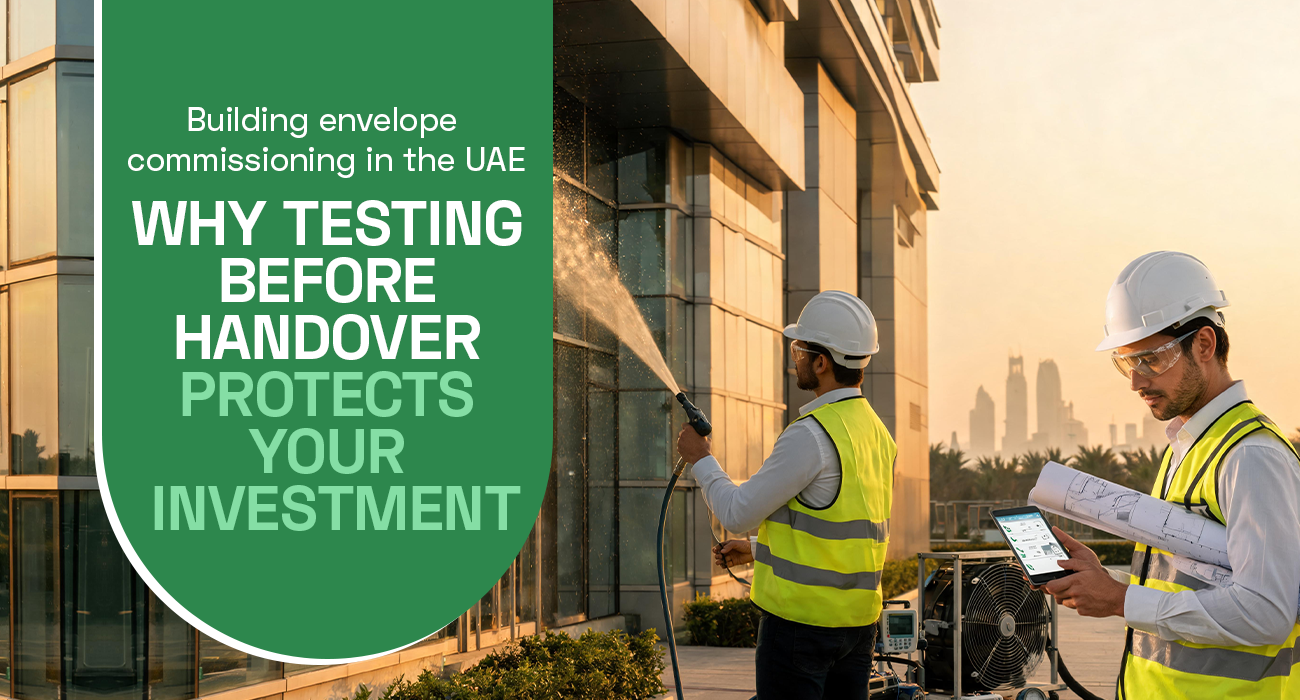
Building envelope commissioning in the UAE: why testing before handover protects your investment
Building envelope commissioning is the quiet difference between a UAE tower that performs the way it was designed to and one that quietly bleeds energy, comfort, and capital for the rest of its life. A finished building can look flawless at handover and still hide defects in its facade that no walkthrough will ever catch. Those defects do not announce themselves. They surface years later as cooling bills that overshoot the model, tenant complaints near the glazing, moisture staining inside the wall, and disputes over who pays to fix it.
The reason is simple. Unlike a cracked tile or peeling paint, the failures that matter most in a building envelope are invisible. A missed connection, a poorly applied sealant, an omitted flashing detail, none of these can be seen, yet each undermines the air-tightness and thermal performance the design promised. Building envelope commissioning exists to find these problems while they are still cheap to correct, before the facade is sealed up and the contractor has demobilised.
At Cornerstone Middle East, we approach commissioning the way a thorough health screening approaches the body. We test, we measure, and we document, so that decisions rest on evidence rather than assumption. This guide explains what building envelope commissioning is, why finding defects late is so expensive, how UAE green building codes raise the stakes, what a commissioning programme includes, and what you receive at the end of it.
What is building envelope commissioning?
Building envelope commissioning, sometimes called building enclosure commissioning or BECx, is a structured process for verifying that a building’s exterior shell performs as intended. It is not a single test. It is a sequence of checks that can run from design review, through construction and facade mock-ups, to a full performance assessment before handover. The goal is to confirm that the walls, windows, curtain walls, and roofing actually control heat, air, and moisture to the standard the project committed to.
A one-off inspection answers the question “is there a visible problem right now?” Commissioning answers a more valuable question: “will this envelope deliver the performance we designed, paid for, and are accountable for?” It combines design and detail review, infrared thermography, air leakage testing, smoke testing, and physical validation into a single defensible picture. For a deeper look at how the thermography itself works, see our companion guide on building envelope inspection and infrared thermography.
Why finding facade defects late is so expensive
The economics of the envelope are unusual, and they work against the owner who waits. During construction, access to the facade is straightforward and a defective detail can be corrected with scaffolding that is already in place. Once the building is finished and occupied, the same correction may require rope access or motorised lifts, work around tenants, and the removal of finishes that were installed over the defect. The cost of the repair has not changed much, but the cost of reaching it has multiplied.
Scale makes it worse. A facade is built from the same details repeated across thousands of square metres. A connection that leaks on one floor very often leaks on every floor, because the same crew installed it the same way throughout. A deficiency that would cost little to correct once can therefore repeat dozens or hundreds of times across an elevation, and an inaccurate assessment of that deficiency is repeated just as widely. Catching it early, in one location, before it is replicated, is where commissioning pays for itself.
Then there is the cost that never appears on a repair invoice. Air leakage in the UAE climate pulls warm, humid outdoor air into cooled interiors, raising latent cooling loads for the entire life of the building and risking condensation and corrosion within the wall. Left undiscovered at handover, these become the owner’s problem and, frequently, a claim against the developer. Commissioning converts a future dispute into a documented finding that can still be resolved by the party responsible for it.
UAE green building codes raise the stakes
The UAE operates some of the most demanding building performance frameworks in the region, and the envelope sits at the centre of all of them. In Dubai, the Al Sa’fat Green Building Evaluation System and the Dubai Green Building Regulations and Specifications set thermal performance and energy targets for new buildings. In Abu Dhabi, the Estidama Pearl Rating System does the same, with envelope thermal performance and air-tightness contributing directly to the rating a project achieves.
These frameworks govern what the building is designed to do. They cannot, by themselves, guarantee that the building as constructed actually delivers it. That gap between design intent and built reality is exactly what commissioning closes. Independent verification, using infrared thermography and air leakage testing, confirms on site that the thermal and air-tightness performance behind the rating has genuinely been achieved. For developers, that protects the rating, the marketing claims made around it, and the investment itself. For owners and facilities teams, it provides documented proof of performance on the day the building changes hands.
What a building envelope commissioning programme includes
A credible commissioning programme is a multi-tool process, not a single scan. Each step adds a layer of certainty to the next.
Design and detail review
Before anything is measured, the critical envelope details are reviewed against building science principles and the project’s performance targets, so that testing later focuses on the conditions most likely to fail.
Infrared thermography
Facade thermal imaging maps temperature variations across the envelope to reveal air leakage, thermal bridging, and trapped moisture without destructive opening. In the UAE this is usually carried out at night, once surfaces have shed absorbed solar heat.
Air leakage and blower door testing
High-power, multi-fan blower door systems hold the building or a floor at a known pressure differential, forcing air through any weakness so it becomes both visible to the camera and measurable as a leakage rate that can be compared against the design specification.
Smoke testing and validation
Portable smoke generators trace specific leakage paths in real time, and where needed, targeted dismantlement confirms the root cause directly. This validation step is what separates a confident diagnosis from a guess, and it is the basis for a remediation recommendation that will actually work.
The work is conducted in line with recognised standards for building enclosure commissioning and air leakage testing, including frameworks such as NIBS Guideline 3 and ASHRAE Guideline 0 for the commissioning process, and ASTM E779 and ASTM E1186 for air leakage measurement and detection.
What you receive: the commissioning report
The value of commissioning is realised in its documentation. A strong building envelope commissioning report gives an owner or developer a clear, defensible record they can act on and rely on later. It typically includes a register of findings with each anomaly located on the facade and cross-referenced to photographs and thermograms, measured air leakage rates compared against the design target, an interpretation of root cause for each significant finding, and practical remediation recommendations ranked by priority.
Just as importantly, the report establishes a documented performance baseline at handover. That baseline protects every party. It gives the owner evidence of the condition they accepted, gives the developer proof of what was delivered, and gives the facilities team a reference point against which future performance can be measured. In a contractual or green building compliance context, a report prepared in line with recognised standards carries professional weight that an informal scan never can.
When to commission across the project timeline
Commissioning is most powerful when it runs alongside the project rather than after it. At design stage, reviewing critical details prevents predictable failures before they are built. During construction, assessing facade mock-ups and early installations catches a flawed detail before it is repeated across the building. Before handover, a full envelope performance assessment confirms that the finished building meets its targets while access is still practical and any correction is still the contractor’s to make.
Commissioning also has a place after occupancy. When an existing building shows high cooling costs, comfort complaints, or moisture damage, the same toolkit works in investigation mode, identifying the cause so that remediation is targeted rather than speculative. Earlier is cheaper, but it is rarely too late to replace guesswork with evidence.
Lessons from the field
Two examples from real building investigations show why early, validated commissioning matters.
In the first, a newly built commercial building generated air leakage complaints within its first season of operation. Thermographic analysis under positive pressure revealed excessive leakage at the top of multiple curtain wall assemblies, smoke testing confirmed and mapped the sources, and dismantling the top section of the curtain wall was ultimately required to carry out the correct repair. The intervention was costly, but far less costly than years of undetected energy loss and the dispute that would have followed.
In the second, commissioning of a new building identified two separate problems: excessive air leakage through metal panelling below the curtain wall, and significant moisture accumulation within sections of the exterior masonry. The moisture finding was the more serious. A large portion of a masonry wall was holding water, a condition that in a Gulf coastal environment can corrode embedded structural steel and create long-term structural risk if left unfound.
Frequently asked questions
What is building envelope commissioning?
Building envelope commissioning, also called building enclosure commissioning or BECx, is a structured process for verifying that a building’s exterior shell controls heat, air, and moisture as designed. It can run from design review through construction to a pre-handover performance assessment, combining design review, infrared thermography, air leakage testing, and validation.
How is commissioning different from a standard inspection?
A standard inspection checks for visible problems at a single point in time. Commissioning is a process that verifies measured performance against the project’s design targets, using testing and documentation across the timeline. The output is defensible evidence of how the envelope performs, not just a snapshot of its appearance.
When should building envelope commissioning happen on a UAE project?
Ideally it begins at design stage and continues through construction and facade mock-ups, with a full performance assessment before handover while access to the facade is still practical. It is also valuable after occupancy when investigating high energy costs, comfort complaints, or moisture damage.
Does commissioning help with Al Sa’fat or Estidama compliance?
UAE frameworks such as Al Sa’fat in Dubai and the Estidama Pearl Rating System in Abu Dhabi set thermal performance and air-tightness targets that the envelope must meet. Commissioning provides independent, on-site verification that those targets have actually been delivered, which protects both the rating and the long-term performance of the asset.
What does a building envelope commissioning report include?
A typical report includes a register of findings located on the facade and cross-referenced to thermograms, measured air leakage rates compared against the design target, an interpretation of root cause, prioritised remediation recommendations, and a documented performance baseline at handover prepared in line with recognised standards.
Can commissioning be carried out on an existing or occupied building?
Yes. The same toolkit of thermography, air leakage testing, and validation can be used in investigation mode on an existing building to find the cause of high cooling costs, comfort issues, or moisture problems, so that any remediation is targeted and evidence based.
How long does building envelope commissioning take in the UAE?
It depends on the size and height of the building, the facade systems involved, the scope of testing, and whether portable pressurisation equipment is required. The most reliable way to plan is a short scoping conversation about the building and the project programme.
Partner with Cornerstone Middle East
Building envelope commissioning turns the most important and least visible part of a building into something you can see, measure, and prove. It surfaces air leakage, moisture, and thermal bridging while they are still affordable to correct, protects your green building rating, and gives every party a documented record of performance at handover.
At Cornerstone Middle East, our commissioning practice combines infrared thermography, air leakage and blower door testing, smoke testing, and detailed building science analysis into one defensible assessment, delivered across Dubai and Abu Dhabi. Whether you are about to hand over a new development, protecting an Al Sa’fat or Estidama rating, or investigating a performance problem in an existing building, we bring the full diagnostic capability that large UAE buildings demand.
Commission the envelope before handover. It is the cheapest time to find an expensive problem.


Post a comment